
Overview of this Scuba Regulator Lesson
The Scuba regulator is the one piece of scuba gear that keeps you alive underwater. It takes high-pressure air from your tank and delivers it to you breathable, on demand, at depth. Every other piece of gear is important. The scuba reg is non-negotiable.
Most divers treat scuba regulator selection as a budget question. It isn’t. It’s a safety question first, and a long-term value question second. I’ve been servicing regulators for dive shops for over a decade — not on paper, but in practice — and the pattern is consistent: the divers who cut corners on their reg, or who skip services, are the ones who end up with problems at the worst possible moment. A car that isn’t serviced eventually fails. So does a regulator.
This lesson covers what makes a balanced scuba regulator the only sensible choice, DIN vs yoke, the brands worth trusting, and the servicing reality that most gear guides gloss over.
What a Scuba Regulator Actually Does
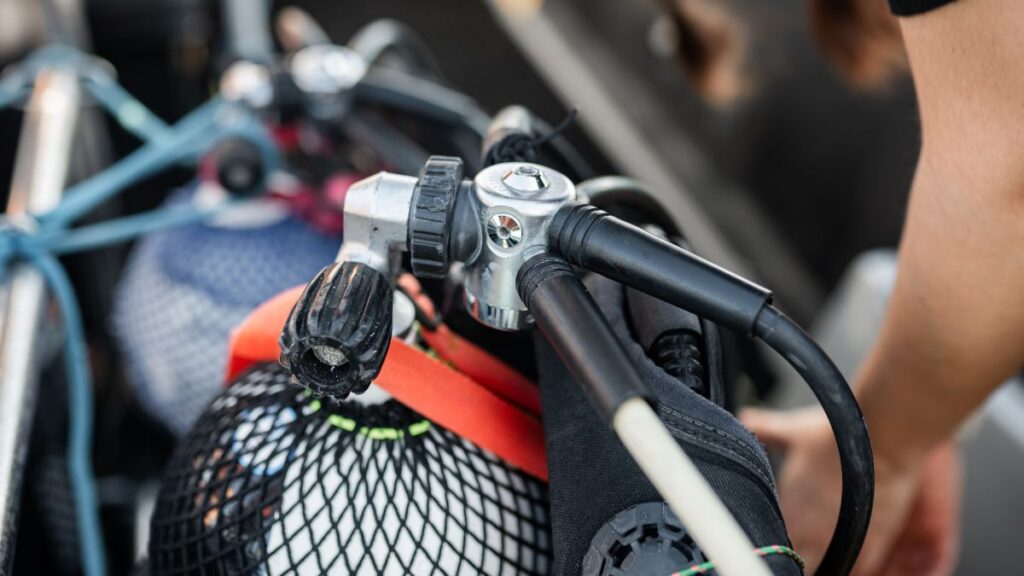
A scuba diving regulator is a two-stage pressure reduction system. The first stage attaches to the tank valve and reduces tank pressure (200–300 bar) to an intermediate pressure of around 8–10 bar. The second stage — the mouthpiece you breathe from — reduces intermediate pressure to ambient pressure, delivering air at whatever pressure matches your depth.
This two-stage process is why regulators can fail in two distinct ways: first stage failure (affecting air supply to the entire system, including your BCD inflator and gauges) and second stage failure (affecting your breathing delivery directly). Understanding this distinction matters when you’re evaluating symptoms and deciding whether to abort a dive.
The scuba regulator consists of:
Pressure gauge, BCD inflator low-pressure hose, and — on any setup worth using — a redundant second second stage (octopus) for buddy-assisted emergency ascents. These are part of the regulator system, not accessories.
Balanced Scuba Regulators vs Unbalanced — Why This Is the Only Relevant Distinction
A balanced scuba regulator delivers consistent airflow regardless of tank pressure and depth. An unbalanced regulator delivers airflow that degrades as your tank empties and as depth increases.
In practical terms: at 40 metres on a half-empty tank, an unbalanced regulator breathes noticeably harder than at 10 metres on a full tank. The breathing effort increases, inhalation resistance rises, and in a demanding situation — a diver working against current, managing stress, or at depth — that increased breathing resistance is exactly what you don’t need.
Balanced regulators deliver the same breath at 5 metres and 40 metres, at 200 bar and 50 bar. That consistency isn’t a luxury feature. It’s the baseline for safe recreational diving.
My rule is simple: only buy a balanced regulator.
An unbalanced reg might be cheaper. It is not better value. If you’re buying once and buying right — which is the point of this gear module — start from balanced and work up from there.
Every serious technical and cave diver uses a balanced regulator. That’s not coincidence.
Join the Weekly Dive
DIN vs Yoke Scuba Regulator — Which Connection Should You Choose
The DIN vs yoke regulator question comes up in every gear purchase conversation, and it’s worth understanding properly rather than defaulting to whatever comes in the box.
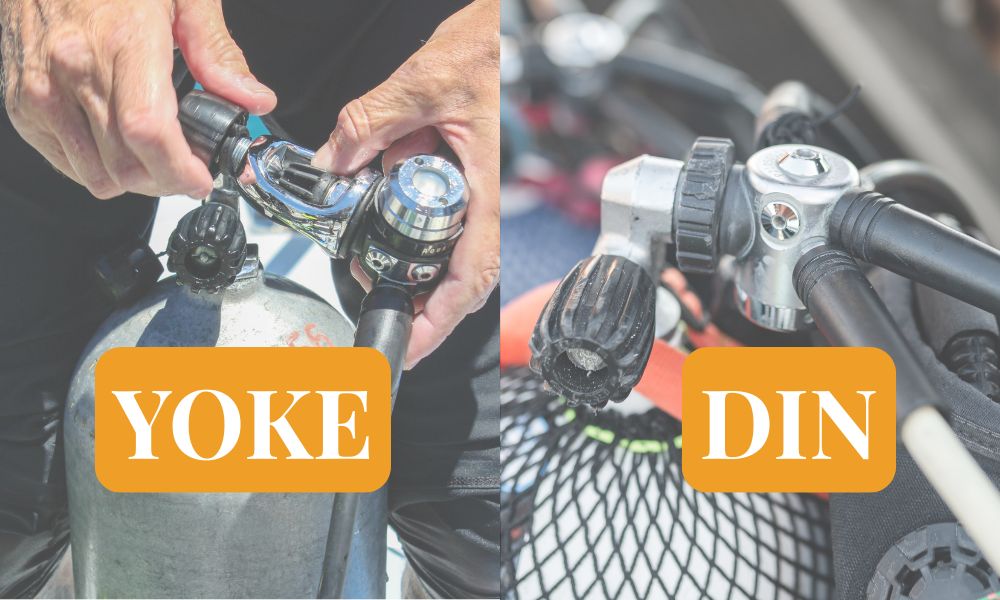
Yoke (A-clamp)
is the traditional connection — a clamp that fits over the tank valve. It’s the global standard for recreational diving and available in virtually every dive shop and liveaboard in the world. If you’re unsure, yoke is the safe default.
DIN
screws directly into the tank valve, creating a sealed, mechanically superior connection. DIN is the technical diving standard for a reason — at high pressures (300-bar tanks), the DIN connection is significantly more secure than yoke. There’s no exposed O-ring, lower risk of regulator blow-off in high-pressure or impact situations, and a cleaner, more streamlined setup.
Most quality DIN scuba regulators come with a yoke adapter insert, which converts a DIN first stage to yoke compatibility in seconds. This gives you the best of both connections — buy DIN, carry a yoke adapter, dive everywhere.
For wreck diving environments and liveaboard travel, DIN is what the experienced divers around you are using.
My personal recommendation:
DIN first stage with a yoke adapter in your kit bag.
The Brands Worth Trusting
I’m not going to give you a ranked list of every scuba regulator on the market — it would be outdated before this page loads.
What I can tell you is which brands I have used for over a decade in cave, tech and recreation, and the most experienced divers I know use, and why.
Scubapro
is the benchmark. The MK series first stages — particularly the MK25 EVO — and the A700 second stage are what serious recreational and technical divers use because they’re reliable, serviceable anywhere in the world, and genuinely excellent at depth.
Scubapro’s service network is global. If something needs attention on a liveaboard in the middle of the Red Sea, a Scubapro reg can be serviced.
Even though I am not a super big fan of their other gear, the Scuba regs are incredible and what I use on my Tec Setup.
Aqualung
makes equally excellent regulators and my all time favorite brand — the Legend and Titan lines particularly. Aqualung’s build quality is high and their service infrastructure is comparable to Scubapro.
I personally have been diving on the Aqualung Balanced Legend for 8 years and you would think it is still brand new.
Apex (Aqualung sister company)
is the technical diving community’s consistent choice for demanding environments and what I use for my sidemount setup.
If you watch what serious technical divers actually dive on, Apex features heavily. Their regulators perform at depth and in cold water at a level that exceeds most recreational requirements — which is exactly why recreational divers should take note.
The pattern is clear: Scubapro, Aqualung, and Apex dominate the regulator choices of divers with thousands of dives under their belts. That’s not marketing. It’s selection by people who know what failure looks like.
What to avoid:
no-name brands, heavily discounted recreational regs from unfamiliar manufacturers, and anything sold primarily on price. Your regulator is not the place to save money.

Servicing Your Scuba Regulator: Why It’s Not Optional and What Happens If You Skip It
Here’s what actually happens inside a regulator over time, and why the annual service interval exists.
Water enters regulators. Even with proper rinsing — thorough, fresh-water rinsing after every dive, dust cap on before the tank valve is opened — micro-exposure over hundreds of dives results in moisture infiltration. In salt water environments, this means the potential for salt crystal formation in the internal chambers of both stages. In and of itself this isn’t immediately catastrophic. Left unaddressed over multiple years, it is.
The corrosion process works like this:
salt deposits form around the small internal ports, orifices, and spring chambers of the first and second stage. Over time — we’re talking two, three, four years without a service — those deposits build up and corrode the metal components around them.
The result is seized orifices, locked adjustment screws, and internal chambers that are mechanically fused by corrosion rather than held together by their designed tolerances.
When a technician opens a regulator in that condition, two things happen: either the components cannot be disassembled at all, making the regulator unserviceable and effectively worthless — you’re buying a new one — or the force required to break the corrosion bond damages the components during disassembly. Either way, the outcome is expensive and avoidable.
Annual servicing prevents this.
A service involves complete disassembly, inspection of all internal components, replacement of all seats, O-rings, and springs (the standard service kit), lubrication of all moving parts, and reassembly and performance testing. The cost is modest relative to a regulator replacement. More importantly, it means a technician sees inside your regulator every year — before a failure becomes a problem, not after.
The consequence of skipping service isn’t usually catastrophic on dive 101. It’s the free-flow at depth on dive 340 when you’re 30 metres down on a wreck. Or the first stage that delivers inconsistent pressure at the worst moment. Regulators that fail rarely announce their intention. They work fine, and then they don’t.
Tech divers service their regulators annually without exception, or atleast should.
They do this because they understand what the regulator is doing and the cost of failure could be your life. Recreational divers who understand this reach the same conclusion.
Make sure your pre-dive safety check includes checking your regulator — any unusual breathing resistance, free-flow tendency, or bubbling at the first stage is worth investigating before you get in, not after.
Common Scuba Regulator Mistakes
- Buying on price The regulator is where budget thinking costs the most. Start from balanced and work up.
- Opening the dust cap before the tank valve. Water gets into the first stage this way. Put the regulator on with the dust cap in place, purge a small amount of air to equalise pressure, then remove the dust cap and attach. Every time.
- Rinsing scuba regulator poorly. A 30-second splash is not a rinse. Soak the second stage in fresh water, work the purge button while submerged, and rinse the first stage carefully around all ports. Do it after every dive, every day.
- Skipping the service because “it was fine last year.” It was fine last year. This is not evidence that it will be fine at 35 metres next month.
- Not caring about the Alternative air source, because you do not use it often.An octopus is a redundancy, not a courtesy. On a liveaboard in the middle of the Red Sea, your buddy’s backup breath is your backup too. So make sure you give it the same care as the primary.
Key Scuba Reg Takeaways
- Balanced regulator only. Unbalanced regs breathe harder as the tank empties and depth increases. There is no good reason to own one.
- DIN is the superior connection. Buy DIN, carry a yoke adapter.
- Scubapro, Aqualung, and Apex are the brands that serious divers trust. Start there.
- Service annually. Corrosion builds internally regardless of external condition. A regulator that looks fine can be mechanically seized inside. Annual service catches this before it becomes a problem.
Frequently Asked Questions Regarding Scuba Regulators
What is a balanced scuba regulator and why does it matter?
A balanced scuba regulator delivers consistent airflow regardless of tank pressure or depth. An unbalanced regulator breathes increasingly hard as your tank empties and as you go deeper. For recreational diving, balanced regulators are the standard — they maintain the same breathing effort throughout the dive, which matters most in demanding conditions.
What's the difference between DIN and yoke regulators?
Yoke (A-clamp) connects over the tank valve and is the global recreational standard. DIN screws directly into the valve, creating a more secure, sealed connection — the technical diving standard. DIN is mechanically superior at high pressures. Most quality DIN regulators accept a yoke adapter, so buying DIN doesn’t limit compatibility. For travelling divers, DIN with a yoke adapter is the most versatile setup.
How often should I service my scuba regulator?
Once a year, or after every 100–200 dives, whichever comes first. Annual servicing prevents corrosion buildup inside the first and second stages — salt deposits that accumulate over time can seize internal components and make the regulator unserviceable or cause failure. The cost of an annual service is a fraction of a regulator replacement.
What brands do experienced divers recommend for regulators?
Scubapro, Aqualung, and Apex are consistently used by serious recreational and technical divers. Scubapro’s MK series and the Aqualung Legend are strong all-round choices. Apex is the technical community’s preference for demanding environments. Start from these three and choose based on fit, budget within the range, and service availability in the regions you dive.
What's the difference between a balanced and unbalanced regulator?
A balanced regulator adjusts its performance to ambient pressure as you go deeper, delivering consistent airflow on demand regardless of depth.
An unbalanced regulator doesn’t — it performs adequately at shallow depths but can struggle in high-demand situations at depth. For recreational diving below 20 metres, I only recommend a balanced regulator.
Most rental gear is unbalanced; it’s fine for training, but it’s not what you want to own.
Is a more expensive scuba regulator significantly better?
Within the balanced range from reputable manufacturers — yes, up to a point. Higher-end regulators breathe more effortlessly at depth, perform better in cold water and demanding conditions, and tend to be easier and cheaper to service over time. The jump from unbalanced to balanced is the most important one. After that, the mid-range from Scubapro, Aqualung, or Apex is where most divers should be — the marginal gains above that are meaningful primarily for technical applications.