
Introduction: How To Defog A Scuba Mask
Every diver has done it. You roll in, reach depth, pull your mask slightly to clear it — and within thirty seconds the lens has fogged completely. You can see shapes. You can see colours. You cannot actually see anything. You spend the rest of the dive squinting and resenting your own face.
The good news is that a fogging mask is almost never a mask problem. It’s a technique problem. And once you understand why it happens, knowing how to defog a scuba mask correctly becomes straightforward.

Why Your Mask Fogs in the First Place
Fogging happens when warm, humid air from your face contacts a cooler glass surface — the moisture condenses and forms tiny water droplets on the lens. Those droplets scatter light, and what you see is fog.
The reason your mask fogs rather than staying clear comes down to surface chemistry. Glass that hasn’t been treated sits somewhere between hydrophilic (water spreads evenly across it) and hydrophobic (water beads and forms droplets). Untreated glass naturally attracts water droplets — which is exactly what you don’t want.
Anti-fog products work by depositing a thin hydrophilic film onto the glass surface. That film causes condensing moisture to form a uniform, invisible sheet rather than isolated droplets. It’s the same principle behind anti-fog coatings on swimming goggles and car windscreens. When it works correctly, you’re not stopping condensation — you’re changing how that condensation sits on the glass.
The reason most divers defog incorrectly is that they undo the film before it has time to form.
Why New Masks Fog Worst — And How to Fix a New Mask
If you’ve just bought a new mask and you’re struggling to defog a scuba mask despite doing everything right, the mask itself is likely the problem — specifically, the glass.
Most tempered glass lenses have a thin protective coating applied during manufacture. That coating exists to protect the glass during production and transit. It’s not meant to stay there permanently, and it actively interferes with anti-fog because it creates a surface that resists the hydrophilic film bonding properly. Even the best defogger can’t fully overcome it.
The solution is to try remove the coating before you ever dive the mask.
The Toothpaste Method
Apply a small amount of non-gel, non-whitening toothpaste to the inner lens. The mild abrasive in regular white toothpaste breaks down the manufacturing coating without scratching the glass. Rub it in small circles across the entire lens using your finger, leave it for a minute, then rinse and repeat. Depending on the mask, this can take a dozen passes.
Don’t rush it. Apply, rub, rinse, repeat. You’ll know it’s working when the water starts to sheet across the glass evenly rather than beading.
The Flame Method
A lighter held briefly under the inner lens burns off the manufacturing residue. Move the flame steadily — don’t hold it in one place. The coating burns away quickly and you’ll often see a slight blackening that wipes clean. This is faster than toothpaste, but it requires care: get the flame too close to the silicone skirt and you’ll damage it. Use it on the glass only, and keep the mask moving.
In practice, I’ve found that some masks respond in one toothpaste session and some seem to need a combination of both methods across multiple days before they reliably stop fogging.
How to Prevent Your Dive Mask From Fogging: The Step That Gets Skipped
This is where most divers lose it — even divers who’ve been doing this for years.
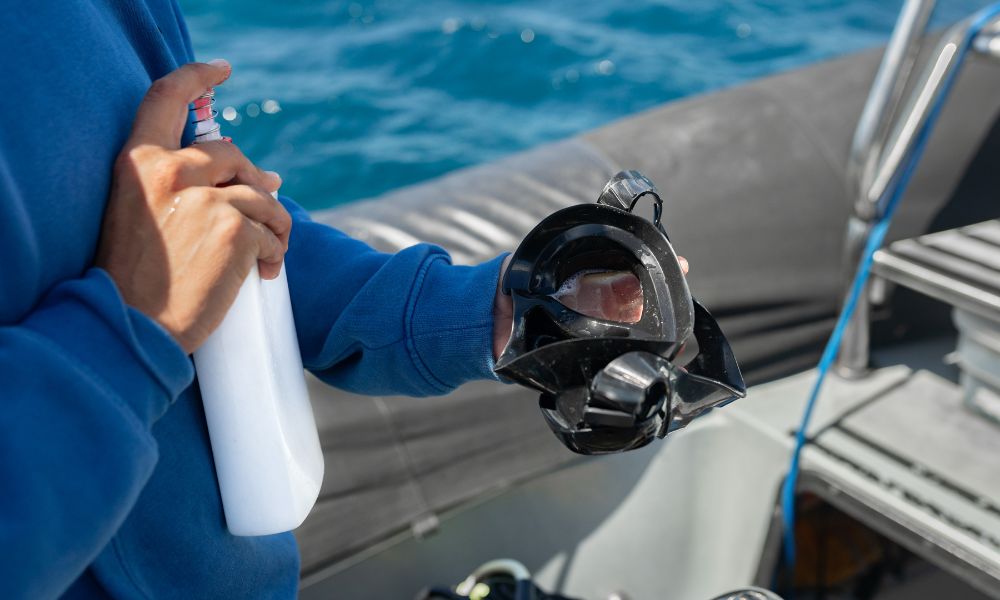
The standard sequence on a dive boat looks like this: someone spits in their mask, swirls it around, immediately rinses it thoroughly with fresh or salt water, and puts it on. That full rinse is exactly the problem.
Here’s what’s actually happening when you apply a defogger or spit correctly: the saliva (or commercial defogger) deposits a thin oil-based film on the glass. That film needs time to bond to the surface and dry slightly. If you rinse it off immediately and thoroughly, you’ve removed the film before it could form. You’re now diving with a wet mask and no barrier — which is exactly the same as not defoggling at all.
The Correct Timing
The right time to defog a scuba mask is during your pre-dive safety check — not at the water’s edge right before entry. Apply your defogger while you’re still running through your buddy check. Let it sit and dry for at least a minute. Then, when you’re ready to enter, rinse it once — lightly, with just enough water to wet the lens — and put it on.
That light final rinse removes excess product and salt while leaving the film on the glass where it needs to be. The difference between a rinse-immediately mask and a let-it-sit mask is significant. The film is what prevents your dive mask from fogging; removing it defeats the whole process.
How to Defog a Dive Mask: The Correct Process, Step by Step
Here’s the full sequence that works consistently.
Step 1: New Mask — Remove the Coating First
If the mask is new, run through the toothpaste or flame prep until the glass sheets water instead of beading it.
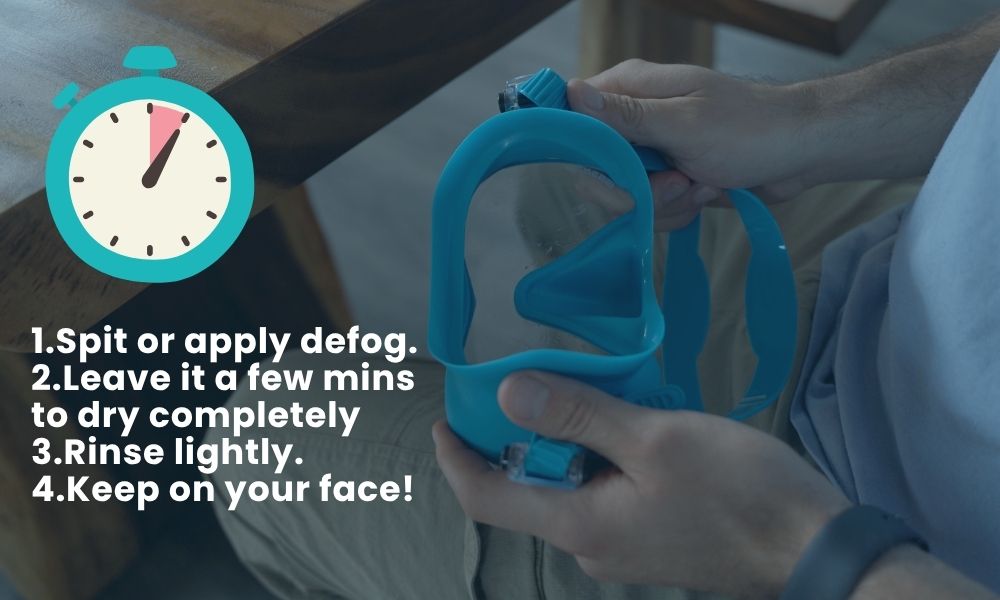
Step 2: Apply During Your Buddy Check
Spit (genuine saliva, not dry lips) or apply a drop of commercial defogger to the inner lens. Commercial products like Stream2Sea or Sea Gold work well and are reef-safe — worth carrying on liveaboard trips where you’re doing four dives a day. Spread the product evenly across the entire lens with your finger.
Step 3: Let It Sit!!
Put the mask around your neck and Leave the mask alone! One minute is fine. Longer is better. Let the film bond to the glass and begin to dry slightly.
Step 4: Light Rinse, Not a Full Wash
When you’re ready to enter the water, rinse the lens once with a small amount of water. Swish, not scrub. You want the glass damp, not stripped.
If you rinse it too early, you just dilute the coating you are trying to apply and just wasted your time – it will fog!
Step 5: Keep the Mask On
Here’s the part most divers ignore: every time you remove your mask on the surface, the glass temperature re-equilibrates to the ambient air. When you put it back on, warm air hits cooler glass — and your film has been partially disrupted by the handling. The fog comes back.
The cleanest solution is to keep your mask on from the moment you apply the defogger until the dive is completely finished. On a liveaboard, that means mask on at entry, mask stays on on the surface and only remove once back on the dive deck.
Re-apply defogger before the next entry. Repeat the above steps.
Why Older Masks Fog Less
You may have noticed that your three-year-old mask gives you far less trouble than your brand new one. This is not luck.
Over time and across many dives, the manufacturing coating on the lens gradually deteriorates. Each toothpaste clean, each rinse, each dive removes a little more. Once that coating is sufficiently degraded, the glass surface behaves differently — anti-fog bonds more easily, and the temperature differential between your face and the water causes less condensation buildup. The mask is genuinely easier to manage.
This is why divers who don’t prep their new masks properly still end up with eventually better-behaved masks — time and use achieve what the prep would have done faster. Prep the mask properly at the start and you simply accelerate that process.
Key Takeaways on How to Defog a scuba mask.
Fogging is a surface chemistry problem, not a mask quality problem. New masks fog because of the manufacturer’s coating on the glass — remove it first with toothpaste or a flame before anything else works properly. Apply defogger during your buddy check, let it sit and form a film, then rinse lightly and keep the mask on. The most common mistake — rinsing thoroughly right before entry — removes the film you just spent sixty seconds building.
Do it right once and you will be back here to thank me 😉
Frequently Asked Questions On How To Defog A Scuba Mask
Why does my scuba mask keep fogging up?
A new mask fogs because of a protective coating applied to the tempered glass lens during manufacturing. This coating prevents anti-fog products from bonding properly to the glass surface. Until that coating is removed — through toothpaste scrubbing or a brief flame treatment — no defogger will work consistently. On an older mask that has been used regularly, recurring fog usually means the defogger is being rinsed off too thoroughly before the film has time to form.
Does spit actually work to defog a scuba mask?
Yes — genuine saliva contains proteins and enzymes that create a hydrophilic film on glass, exactly like a commercial defogger. The key is applying it correctly: spread it across the lens, let it sit for at least a minute, then rinse lightly. The mistake most divers make is rinsing it off immediately and completely, which removes the film before it can work.
What's the best defogger for a scuba mask?
Commercial defoggers (Stream2Sea and Sea Gold are both reef-safe and widely used on liveaboards) outperform spit when you’re doing multiple dives a day and need reliable clarity. For casual diving, spit applied correctly performs well. Avoid any defogger with strong detergents that can irritate eyes. Baby shampoo diluted with water is sometimes recommended — it works on the same principle as commercial products.
How do I stop a new scuba mask from fogging?
Before your first dive, use non-gel white toothpaste to scrub the inner lens in small circles, then rinse and repeat. Depending on the mask, this may take multiple sessions over several days. Alternatively, briefly run a lighter flame across the inner lens to burn off the manufacturing coating — keeping the flame away from the silicone skirt. Once the glass sheets water evenly rather than beading it, the coating is gone and your defogger will work properly.
Should I rinse my scuba mask after applying defogger?
A light rinse — enough to wet the lens and get most of the goo off. A full, thorough rinse is the problem. If you apply defogger and immediately rinse it out completely, you remove the hydrophilic film before it has bonded to the glass. Apply during your pre-dive buddy check, let it sit for a minute, then lightly swish rather than fully rinsing.
Why does my mask fog after I take it off between dives?
Every time you remove your mask, the glass surface temperature adjusts to ambient air temperature. When you put it back on, the warm air from your face hits cooler glass and condensation forms — the thermal differential that causes fogging resets. The defogger film is also partially disrupted each time the mask is handled. The simplest solution is to keep your mask on from the moment you defog it until you’re completely done diving.