
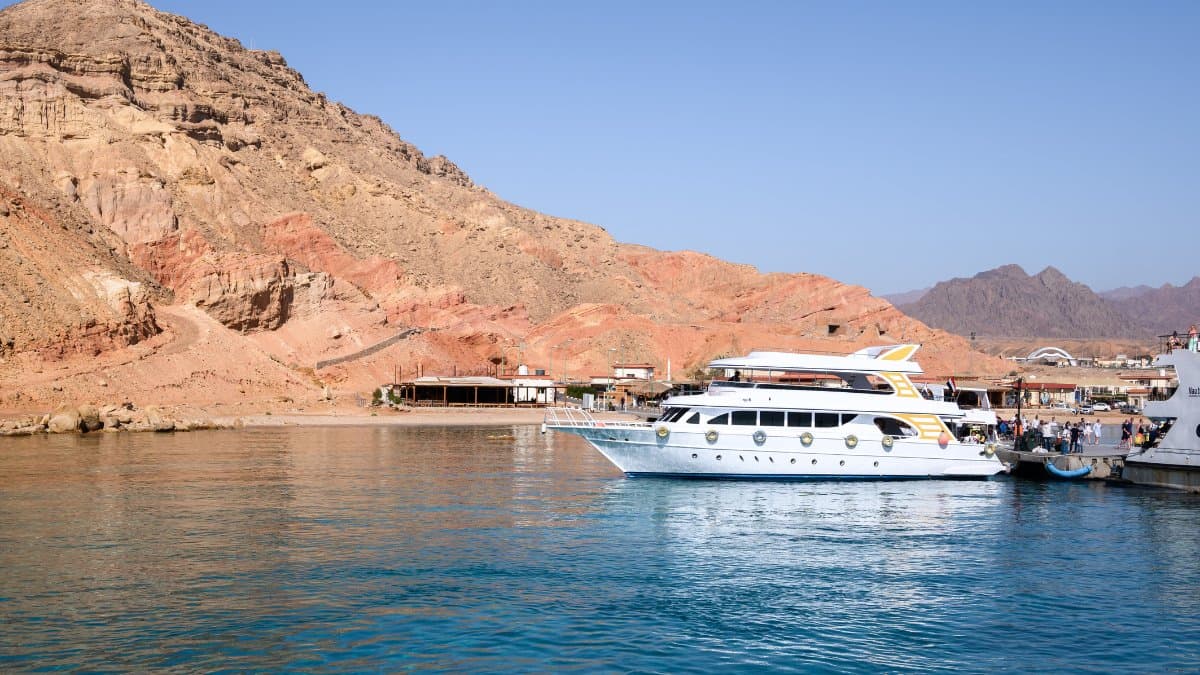
What you can dive from Sharm
Sharm El Sheikh is not a destination you visit because the town is remarkable. You go for what is in the water around it. The house reef diving in the bays near town is respectable, but it is not the reason you book a flight.
What Sharm gives you is a well-organised departure point: hundreds of dive operators, regular liveaboard departures, and sites that would take a full day's transit from other Red Sea bases.
I've dived Sharm El Sheikh multiple times, departing on Freedom 3 and Freedom 4 for north Red Sea liveaboards.
Manie Eksteen, PADI Staff Instructor
Sharm's value is access. Ras Mohammed, the Straits of Tiran, the Thistlegorm and Abu Nuhas are all a boat ride from the marina, though the last two are better from a liveaboard.
| Site | From Sharm | The draw |
|---|---|---|
| Ras Mohammed | 45 minutes by boat | Walls to 80 m, grey reef sharks, hammerheads in the cooler months |
| Straits of Tiran | Day trip | Current, pelagics, hammerheads at Jackson Reef |
| SS Thistlegorm | 3 to 4 hours by boat | A 128 m wartime wreck at 30 m, cargo still in the holds |
| Abu Nuhas | Across the Strait of Gubal, by liveaboard | Four wrecks on one reef, including the 100 m Giannis D |
Still choosing where to dive in Egypt? Start with the Red Sea overview.
SS Thistlegorm
The Thistlegorm is a 128-metre British wartime cargo ship, sunk by a German bomber in 1941. It sits at 30 metres in the Strait of Jubal, beyond the 18 metre (60 ft) limit of Open Water certification, so it is a dive for Advanced Open Water divers and above.
It remains the single most impressive wreck dive I have done anywhere in the world.
Manie Eksteen, PADI Staff Instructor
The cargo is what makes it. The holds still contain Second World War military equipment: BSA motorcycles, Bedford trucks, Bren gun carriers, rifles, train carriages, ammunition. Nothing has been removed, and the motorcycles are still stacked in rows. The scale doesn't register until you're in the hold, watching fish drift through the spokes of a wartime Triumph.
You can dive it as a day trip, but a liveaboard is better. The site has a strict one-hour-on-site rule during daylight hours, while liveaboards that moor overnight can dive at 5am with no other boats present. That early dive is made by torchlight with the rest of the site still dark, so treat it as a night dive: make it only if you are trained for night diving, and go into the holds only as far as your training and your guide allow.
The full SS Thistlegorm diving guide
Ras Mohammed National Park
Ras Mohammed sits 45 minutes south of Sharm by boat, the closest headline site to the marina. Shark Reef and Yolanda Reef are the main events: a soft-coral-draped wall diving to 80 metres, consistent grey reef shark sightings, hammerheads in the cooler months, and the Yolanda cargo of bathroom fittings, encrusted, at 25 metres.
It is a protected national park. The entry fee is usually included in the dive operator price, so confirm that with yours. Reef health is visibly better than at unprotected sites, a direct result of the protection.
Straits of Tiran
Four reefs run through the Straits of Tiran: Jackson, Woodhouse, Thomas and Gordon, named after the British naval officers who charted them. They sit on the passage between the Gulf of Aqaba and the Red Sea, which means consistent current and consistent pelagics.
Hammerheads are sighted here regularly, particularly at Jackson Reef, where the current runs strongest. The walls are good, and the hard coral coverage is exceptional in places. Jackson and Thomas are the most dived. Woodhouse and Gordon see less traffic and reward the detour.
You can dive the Straits of Tiran on day trips from Sharm. The crossing can be choppy on windy days, which matters if anyone in your group is prone to seasickness. Conditions from October to April are generally calmer.
The Straits of Tiran diving guide
Abu Nuhas wrecks
Four shipwrecks on a single reef, just north of Shadwan Island and west to south-west of Sharm across the Strait of Gubal. It is not typically a day trip: the distance and transit time make a liveaboard the practical option. The Giannis D is the headline wreck, 100 metres of intact Greek cargo ship at recreational depths. Going inside any of these wrecks, holds included, is overhead diving and takes wreck training and a guide. On a first wreck dive, stay outside.
The Abu Nuhas shipwrecks guide
House reefs
A few days in Sharm before or after a liveaboard? Several sites are worth a shore entry or a short boat ride:
- Near Garden and Middle Garden in Na'ama Bay are the most accessible, with shallow coral gardens suited to check-out dives and night diving. Fish life is good; reef health is variable.
- The Tower (Ras Um Sid) is a wall dive starting at 6 metres and dropping steeply, one of the better shore dives available directly from Sharm. The soft corals on the wall are excellent.
- Far Garden rewards more experienced divers with richer fish life and less diver pressure than the Na'ama Bay sites.
Dahab, with the famous Blue Hole, is only a 90-minute road transfer away.
When to go
The Red Sea around Sharm is diveable year-round. What changes is the water temperature, the visibility, the marine life and the crowds. October to February is the window to aim for.
| Months | Go for | Boats and prices |
|---|---|---|
| October to February | Hammerheads at Ras Mohammed and Tiran (most reliable October to January), big schools of barracuda and trevally | Highest prices; book early, especially November to January |
| March to May | Good visibility, active and spawning reef fish, occasional mantas | Less crowded, slightly lower prices |
| June to September | Good visibility and the most colourful corals; hammerheads largely absent | Lower prices than winter; busy resort diving |
October to February. Water temperatures fall from about 27–28°C in October to 22–24°C in January and February, manageable in a 5 mm wetsuit, and visibility is consistently 20 metres or better. The cooler water brings in the pelagics.
The Red Sea, with Sharm as a departure port, is one of our best liveaboard destinations to dive in November.
I have personally been here over the November time period multiple times…
Manie Eksteen, PADI Staff Instructor
March to May. The sweet spot if you're flexible on timing: comparable diving quality to winter, slightly lower prices and shoulder-season availability. The water warms from about 22°C in March to 24–26°C in May, and liveaboards have a more relaxed atmosphere.
June to September. Hot. Air temperatures regularly exceed 35°C and the water climbs from about 26°C in June to 29–30°C in August. If your dates are fixed in summer, Sharm is still very worthwhile. Just don't come specifically for sharks in July.
Liveaboard or day trip?
Take a liveaboard if you can. The Thistlegorm dawn dive alone is worth the cost. If day trips are your budget, Ras Mohammed and the Straits of Tiran still give you excellent Red Sea diving, as long as you go in season.
Choose a liveaboard if:
- You want to dive the Thistlegorm properly (the night or dawn dive is the benchmark).
- You want Abu Nuhas. The four wrecks need more than a day trip window.
- You want to reach Brothers, Daedalus, Elphinstone or the southern Red Sea sites.
- You're a committed diver who wants 3–4 dives a day and maximum water time.
Choose day trips if:
- Your budget doesn't extend to a liveaboard.
- You have family or companions who aren't diving, and you need to be back each evening.
- You're happy with Ras Mohammed and the Straits of Tiran as your main sites. Both are day-trip accessible.
Liveaboard costs vary by route and boat. On our Red Sea liveaboard ranking, seven-night south circuit trips run from about $1,190 to $1,500+ per person and shorter north itineraries start around $600 (Divebooker prices, as of May 2026). Look for north itinerary boats that list the Thistlegorm and Ras Mohammed on the schedule.
Ready to look at boats?
Choosing a dive operator in Sharm
Sharm has hundreds of dive operators, and quality varies enormously. A few things separate the good ones from the average:
- Boat condition and setup. Day trip boats should have a well-organised dive deck, a working surface marker buoy system and a first aid kit that's actually stocked. Have a look before you book.
- Guide-to-diver ratio. At open water sites with current, such as Ras Mohammed and the Straits of Tiran, you want no more than 6 divers per guide. More than that and someone gets lost when the current picks up.
- Night diving access. For the Thistlegorm, ask operators how early they depart for the site. Boats that leave Sharm the evening before get the dawn slot. Day trip operators leave at 5–6am and arrive after the good window.
- PADI or SSI affiliation. Most reputable operators in Sharm are affiliated. It's a basic quality threshold, not a guarantee, but it's a starting point.
Before you go
Confirm the hyperbaric chamber's status and nitrox availability with your operator before you book.
| Item | What to know |
|---|---|
| Getting there | Sharm El Sheikh International Airport (SSH) has direct connections from the UK, Europe and the Middle East. Charter flights from the UK typically take 4–5 hours. |
| Visa | Most nationalities receive a Sinai-only stamp on arrival, valid for 15 days and free of charge. It covers the Sharm area and Sinai diving. For the rest of Egypt you need a full Egypt visa. |
| Money | Egyptian pound (EGP). US dollars are widely accepted for dive services. Carry both. |
| Water and wetsuit | About 22–24°C from January to April, 24–26°C in May and December, 26–28°C in June, October and November, and 28–30°C from July to September (sea-surface averages). A 5 mm suit from October to April, 3 mm from May to September. |
| Hyperbaric chamber | Sharm El Sheikh has one. Confirm its current operational status with your operator before diving. |
| Nitrox | Widely available from most operators and liveaboards, but you need your own nitrox certification to use it. Confirm before booking if it matters to your dive plan. |
| Culture | Get familiar with local culture and religion before you travel, including dress codes. |
Questions
Is diving in Sharm El Sheikh worth it?
Yes, mainly for what is within reach of it. Sharm sits at the tip of the Sinai Peninsula, close to the SS Thistlegorm, Ras Mohammed National Park, the Straits of Tiran and Abu Nuhas. The town is a resort town: functional, but not the draw.
What is the best time of year to dive Sharm El Sheikh?
October to February for the best combination of visibility, water temperature and pelagic encounters. Hammerheads are most reliably seen at Ras Mohammed and the Straits of Tiran from October to January. March to May is excellent and less crowded. Summer diving is still good, but the big animals are less present.
Do I need a liveaboard to dive Sharm El Sheikh?
No. Day trips to Ras Mohammed and the Straits of Tiran are readily available. But for the Thistlegorm, a liveaboard gives you the dawn dive, which is significantly better than the day trip experience. For Abu Nuhas and more remote sites, a liveaboard is the only practical option.
What experience level do I need to dive Sharm El Sheikh?
Anemone City and the house reefs around Na'ama Bay are suitable for newly certified Open Water divers. Ras Mohammed and the Straits of Tiran require comfort in moderate current, and Advanced Open Water is recommended. The Thistlegorm is not for Open Water divers. It lies at 30 metres, and Open Water certification stops at 18 metres (60 ft). Advanced Open Water, which covers 30 metres (100 ft), is the minimum, and you should stay within the depth limit of your certification and experience. See the Thistlegorm guide.
Is it safe to travel to Sharm El Sheikh for diving?
The diving environment in Sharm El Sheikh is well established, with reputable operators, functioning facilities and a hyperbaric chamber. Travel safety conditions in Sinai have varied over the years, so check your government's current travel advisory before booking. Most dive operators in Sharm work with divers from across Europe and the UK regularly and can advise on current conditions.