
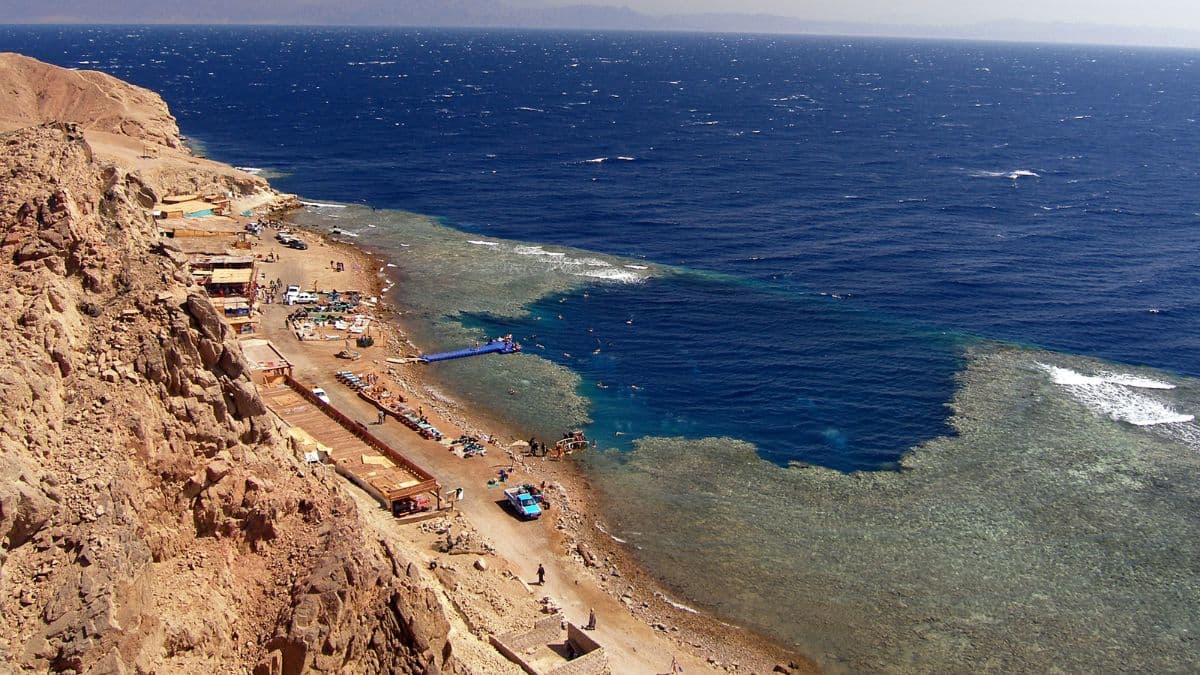
The Dahab Blue Hole is an excellent shore dive inside your certification limits, and a deadly one outside them. It has two reputations, and both are earned.
It is one of the best shore dives in the Red Sea. It is also called "the world's most dangerous dive site", after fatalities reported at the Arch.
As a diving instructor, I'm more interested in you having both pieces of information than in writing something that only tells you what you want to hear.
Manie Eksteen, PADI Staff Instructor
What the Blue Hole is
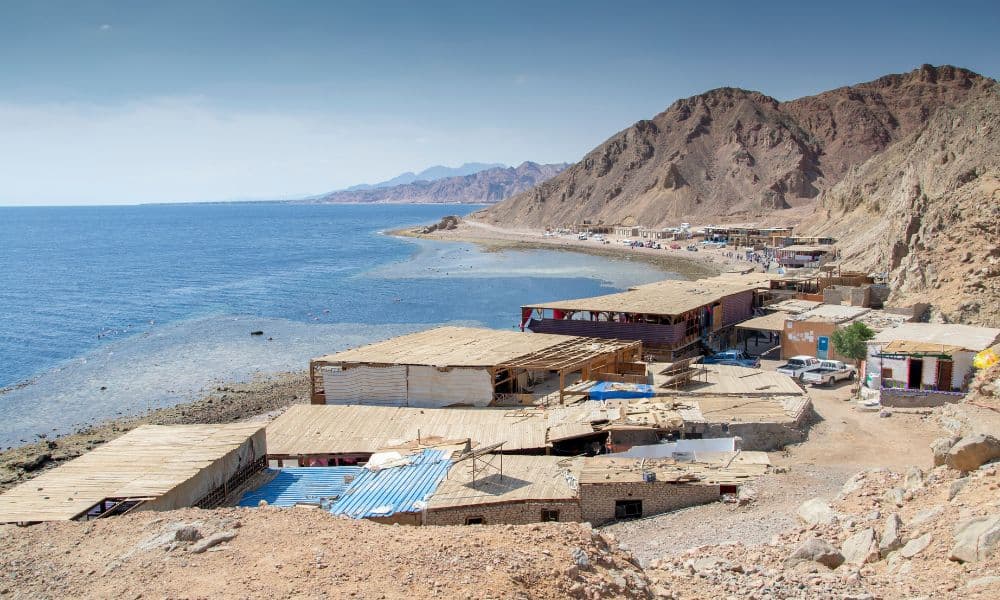
The Blue Hole is a submarine sinkhole on the Red Sea coast of the Sinai Peninsula, about 10 km north of Dahab town. It sits on the shoreline: you walk down stone steps and enter from the shore. No boat needed.
The hole is roughly circular, about 60 metres across at the surface, and drops to more than 100 metres at its deepest point. Figures from just over 100 m to about 130 m are quoted, depending on who measured it and where, and none of that is within recreational reach. The inner walls are covered in coral down to the limit of recreational depth.
The outer reef falls away steeply from the saddle at the northern rim. That is where the site meets the open Red Sea, and where the Arch sits.
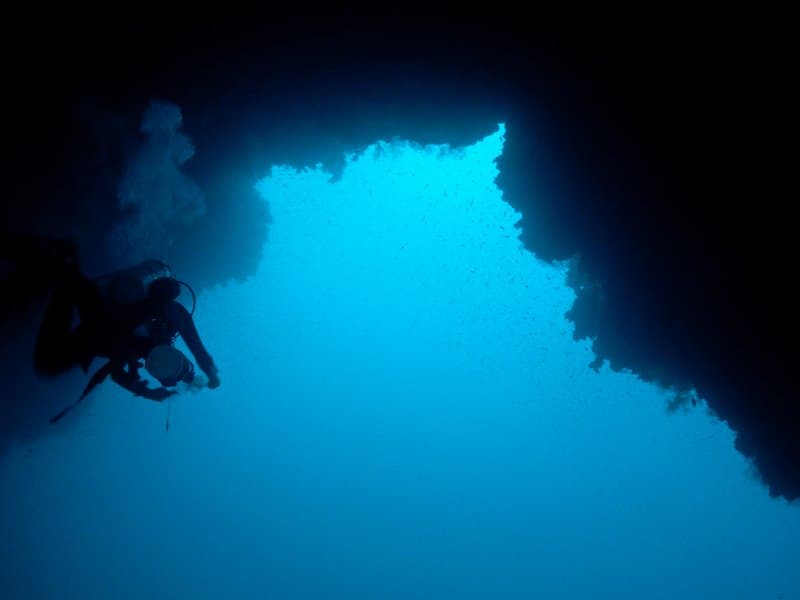
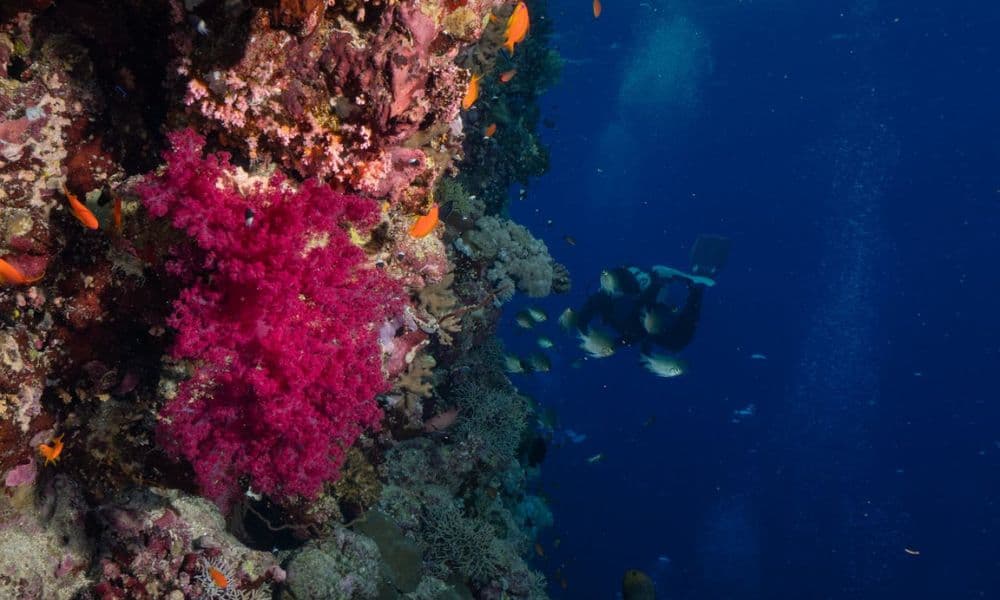
At recreational depths, 18 to 30 metres, the coral is healthy, the fish life is rich, and you float above a dark blue void that drops far below you. Visibility is good on most days.
How deep is each part of the Blue Hole?
The hole is deep, but the dive you can do is shallow. Each part has its own depth, and only the first three are recreational.
| Part | Depth | Who can dive it |
|---|---|---|
| The Saddle, the shallow shelf at the seaward edge | About 6–7 m | Snorkellers and divers of every level |
| The inner rim and wall | 18–30 m | Open Water divers to 18 m, Advanced Open Water to 30 m |
| The Bells chimney | To about 25 m | Advanced Open Water or equivalent |
| The Arch, the tunnel through the reef wall | About 55–56 m, and 26 m long | Technical divers only |
| The hole itself | More than 100 m, up to about 130 m by some measures | No one, by recreational means |
Dive the inner rim or the Bells entry
Both dives stay within recreational limits. Neither goes below 40 metres, and neither involves the Arch. Your certification sets your depth:
| Certification | Depth limit | At the Blue Hole |
|---|---|---|
| Open Water | 18 m | The inner rim, kept within 18 m |
| Advanced Open Water | 30 m | The whole inner rim and the Bells chimney |
| Deep Diver | 40 m | Nothing here needs more. 40 m is the recreational ceiling |
| Technical (extended range or mixed gas) | Beyond 40 m | The Arch |
| Dive | Depth | Level | What you do |
|---|---|---|---|
| Inner rim | 18–30 m | Open Water divers stay within 18 m, Advanced Open Water to 30 m | Down the inside wall, around the perimeter, then up through the centre. Finish at the saddle and exit up the steps |
| Bells entry | Chimney to about 25 m, then the reef wall | Advanced Open Water or equivalent | Enter at Bells, 100 m north of the Blue Hole, drop down the chimney, work the outer reef wall south, pass the saddle and enter the Blue Hole from outside |
The inner rim is the straightforward version. Visibility is typically 20+ metres, and the coral wall is the show: sea fans, table corals and the fish life of a healthy reef.
Bells is the more interesting dive for experienced divers. You get the open reef wall on the way in and the enclosed sinkhole on the way out, two environments in one dive. Most dive centres recommend it for divers who want more than the inner rim alone.
I would recommend doing it over 2 days and do both, they are both awesome.
Manie Eksteen, PADI Staff Instructor
Manie's personal favourite is Bells. He loves closed spaces and finds the rock chimney descent incredible, and you do not have to take it if you do not want to.
The Arch is a technical dive
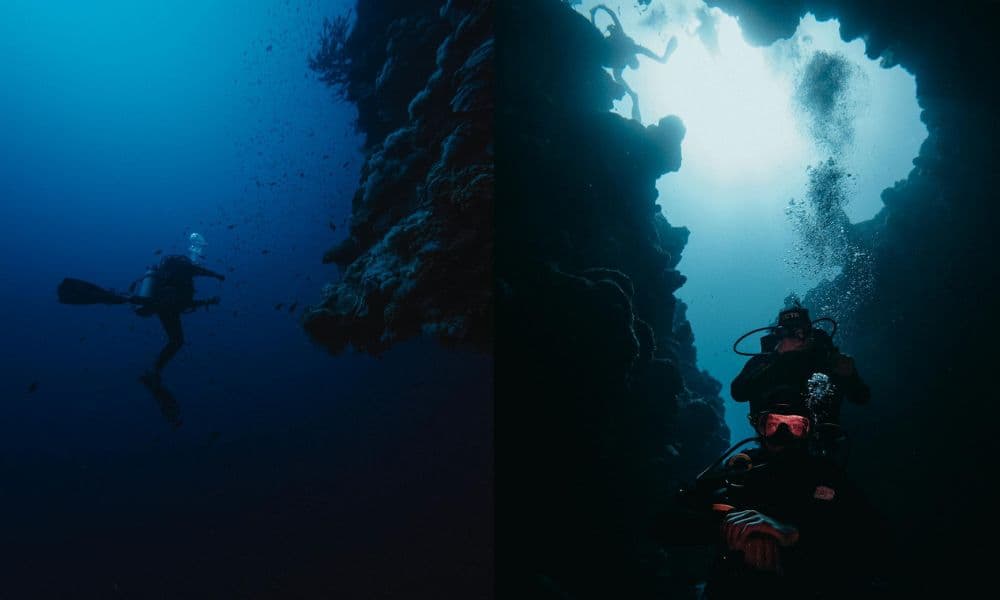
Do not attempt the Arch on a recreational tank. It sits at approximately 56 metres, in a tunnel about 26 metres long that runs through the reef wall from the hole to the open Red Sea. You come out on the outer wall in open water and ascend from there.
At 56 metres the dive is beyond every recreational limit: 18 metres for Open Water, 30 metres for Advanced Open Water, and 40 metres as the recreational ceiling (PADI). It needs technical training with proper gas planning, and it cannot be done safely on a single tank of air. That is physics and physiology, not opinion.
Reported fatalities at the site centre on the Arch, and the pattern is a familiar one. A recreational diver with little deep experience tries it on a standard tank, and it goes wrong in one of two ways:
- Nitrogen narcosis sets in at the tunnel (the "Martini effect" at this depth is real and significant), and disorientation sends them deeper instead of through.
- They attempt the crossing, use their gas faster than planned and surface without enough air for a safe ascent.
The site is not uniquely hostile. The Arch is deadly because of a specific trap: it is visible to recreational divers and reachable on a single tank, but it needs technical gas management to exit safely. That gap between "looks reachable" and "is safely reachable" has killed many divers.
To dive the Arch, get technical certification that covers its depth, plan the dive with the right gas, and go with a qualified technical guide. Several Dahab centres teach technical diving and specialise in Arch preparation.
Done properly, with training and the right gas, it is a manageable dive. Done on a single recreational tank, it is a known killer.
How many people have died at the Blue Hole?
Nobody knows exactly, because there is no official count. One Dahab technical diver, who has recovered bodies from the site, estimated in 2012 that more than 130 divers had died in the previous 15 years, and another estimate runs as high as 200. The figures include some snorkellers who died at the surface, as well as scuba divers.
The divers' deaths centre on the Arch, as above. They are a reason to dive within your certification, not a reason to skip the inner rim and Bells.
Snorkelling and freediving at the Blue Hole
Snorkelling needs no certification. Most snorkellers enter over the Saddle, a shallow shelf about 6 m deep, and stay along the reef edge. The hole beside it falls past 100 m, so stay over the shallows, and never snorkel alone.
Freediving is popular because the depth is right off the shore and there is no current. Blackouts are a real risk, so freedive only within your training and always with a trained buddy watching (DAN).
The Blue Hole as a shore-dive base
Set the Arch aside and this is a straightforward shore-diving base. Several dive centres operate from the site, there are restaurants and cafes right on the water, and entry and exit are as easy as shore diving gets.
The inner rim, the Bells drift and the Canyon give experienced shore divers a full day without a boat. The Canyon is a separate site 500 metres south, a long crack in the reef with swim-throughs and good marine life. In calm conditions you can dive the outer reef wall between sites on a single tank.
Dahab itself is an easy base for a dive holiday. The town is relaxed, accommodation runs from budget backpacker to comfortable mid-range, and the number of dive centres keeps prices competitive.
When to dive Dahab
Dahab is diveable all year. March to May and September to November are the best windows: calm seas, good visibility and manageable crowds.
| Month | Water | Diving |
|---|---|---|
| January | 22–23 °C | Cooler, windier |
| February | 22–23 °C | Cooler, windier |
| March | 22 °C | Best window |
| April | 22–23 °C | Best window |
| May | 24–25 °C | Best window |
| June | 25–26 °C | Hot and busy, diving still good |
| July | 27–28 °C | Hot and busy, diving still good |
| August | 28–29 °C | Hot and busy, diving still good |
| September | 27–28 °C | Best window |
| October | 26–27 °C | Best window, calm and quieter |
| NovemberNow | 25–26 °C | Best window |
| December | 24–25 °C | Cooler, wind less predictable |
Wind is the main variable. Dahab sits in a wind corridor, and in winter swell from the Gulf of Aqaba can push through and make shore entries rough, so check the forecast. From January to April, when the water is 22–23 °C, a 5 mm wetsuit is appropriate.
June to August is hot and crowded with summer visitors, many of them not divers. The diving is still good. The atmosphere is less so.
Water temperatures are long-term averages for Dahab. For the rest of the Red Sea month by month, see the best time to dive the Red Sea.
Visiting the Blue Hole: fee, hours and getting there
The Blue Hole is about 10 km north of Dahab town, a 15 to 20 minute drive on the coast road. A taxi from town costs about EGP 100–200 one way as of July 2026, so agree the fare first.
| Visiting | What to know |
|---|---|
| Hours | The site opens around 8 am, and visitors are generally asked to be out of the water by 4 pm |
| Entry fee | Around USD 25 per person in cash as of July 2026, covering a checkpoint and the site charge. Your dive centre will know the current price |
| From Dahab town | About 10 km, 15 to 20 minutes by taxi |
| From Sharm El Sheikh | Dahab is 90–115 km up the coast, 1.5 to 2 hours by taxi, bus or private transfer. The Blue Hole is another 15 to 20 minutes |
| Snorkelling | No certification needed. See above |
The Blue Hole is at Dahab, not at Sharm El Sheikh or Hurghada. Day trips run from Sharm, and the Sharm El Sheikh guide and the Hurghada diving guide cover those bases.
Most dive centres at the site cater to mixed-ability groups. For Bells, confirm that your guide knows the site. It is not a navigation challenge, but a guide who runs it regularly adds value in timing the entry and reading conditions.
Technical divers will find specialist centres in Dahab that run Arch preparation courses and guided dives. Do not attempt the Arch with a recreational guide. The gas planning alone needs technical instruction.
Manie on two months in Dahab
I spent a total of 2 months living in Dahab staying in town, diving all of the shore dives and the Blue Hole is still one of my favorites.
Manie Eksteen, PADI Staff Instructor
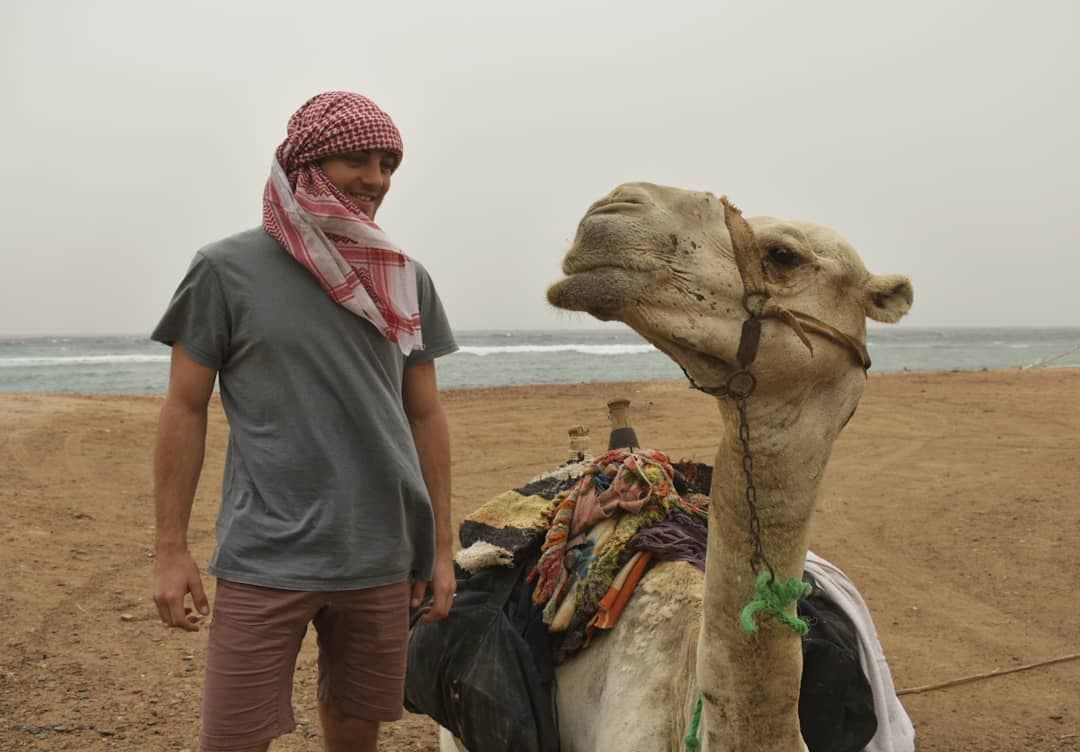
He was there in October and November, when there were hardly any tourists at the hole early in the morning. November is his favourite time in Dahab: fewer crowds and shoulder season.
Dahab belongs on your Red Sea list. Spend a day or two there, enjoying the laid-back lifestyle of the Bedouin community, before a liveaboard or as your last two days before heading home. Between dives, Manie liked to kick back, relax and drink locally brewed tea.
If you dive it, we would like to hear how it went. Message us on Instagram.
Add a Red Sea liveaboard to your Dahab trip
Many divers pair a Sharm-based liveaboard with a day or two in Dahab, before or after. A north Red Sea liveaboard from Sharm covers the SS Thistlegorm, Ras Mohammed and Abu Nuhas, and Dahab adds shore diving in a completely different environment.
The Bells, Blue Hole and Canyon combination fills a day of shore diving. It is practical, and worthwhile if your schedule allows.
If you are not sure whether shore diving or a liveaboard suits you better, read shore vs liveaboard, and which one is right for you.
Ready to look at boats?
Questions
How deep is the Dahab Blue Hole?
More than 100 metres at its deepest, and figures up to about 130 metres are quoted. Recreational dives stay far shallower: the inner rim is dived to 18–30 metres and the Bells entry to around 25 metres.
The Arch, the tunnel through the reef wall, sits at about 56 metres, beyond recreational limits. It needs technical training and the right gas.
Is the Dahab Blue Hole safe to dive?
Within your certification limits, on the inner rim or through Bells, yes. It is one of the best shore dives in the Red Sea, with good facilities, clear water and excellent coral.
The site's dangerous reputation comes from recreational divers attempting the Arch at 56 metres on a single tank. Dive within your limits and it is a straightforward multi-level dive with predictable conditions.
Why is the Blue Hole so dangerous?
The danger is the Arch, not the site as a whole. The Arch sits at 56 metres, beyond recreational limits, but it can be seen and reached from inside the sinkhole, which is a trap for underprepared divers. Nitrogen narcosis at that depth impairs judgement, and several divers have made poor decisions inside the tunnel and not survived.
Can beginners dive the Dahab Blue Hole?
The inner rim suits Open Water divers with basic buoyancy, staying within their certification depth limit. The Bells entry suits Advanced Open Water or equivalent. The Arch is technical diving and needs technical certification whatever your experience.
Do I need a dive centre, or can I dive independently?
Shore diving without a guide is possible, and many experienced divers do it. On a first visit, a local guide adds value: they know the entry timing, the current patterns and the conditions, which change daily. For Bells especially, a guide on the first dive is a sensible investment.
Where is the Dahab Blue Hole?
On the Sinai coast of the Red Sea in Egypt, about 10 km north of Dahab town and 90 to 115 km up the coast from Sharm El Sheikh. It is not at Sharm El Sheikh or Hurghada, and it is not the Great Blue Hole in Belize, which is a different sinkhole in the Caribbean.
How much does it cost to enter the Blue Hole?
Around USD 25 per person, paid in cash, as of July 2026. That covers a checkpoint and the site charge. The site opens around 8 am, and visitors are generally asked to be out of the water by 4 pm. Your dive centre will know the current price.
How do I get to the Blue Hole from Sharm El Sheikh?
Take a taxi, bus or private transfer to Dahab, 90 to 115 km up the coast, which takes 1.5 to 2 hours. The Blue Hole is another 15 to 20 minutes by taxi, about 10 km north of town. Day trips run from Sharm, so check what the price includes.
Can you snorkel at the Blue Hole?
Yes. Snorkelling needs no certification. Most snorkellers enter over the Saddle, a shallow shelf about 6 m deep, and stay along the reef edge. The hole beside it falls past 100 m, so stay over the shallows, and never snorkel alone.
Can you freedive at the Blue Hole?
Yes, and it is popular because the depth is right off the shore, with no current. Blackouts are a real risk. Freedive only within your training, never alone, and always with a trained buddy or safety diver watching you.
How many people have died at the Blue Hole?
There is no official count. One Dahab technical diver estimated in 2012 that more than 130 divers had died in the previous 15 years, and another estimate runs as high as 200. The figures include some snorkellers who died at the surface, and the divers' deaths centre on the Arch.