
Introduction into Elphinstone Reef
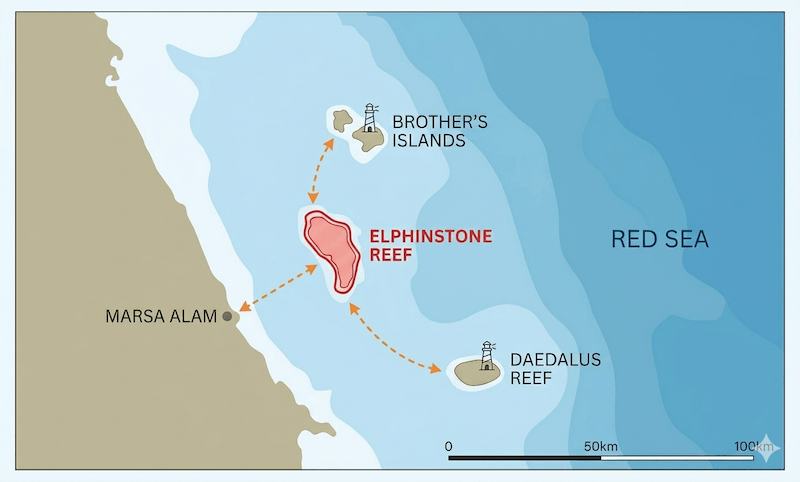
This Red Sea dive site is a 300-metre submerged ridge sitting 10 kilometres off the Egyptian coast near Marsa Alam. It rises from deep water to within a few metres of the surface, and the two plateaus at its northern and southern tips are where the best diving happens.
If you’ve done Brothers Islands and you’re wondering what else the southern Red Sea has to offer — this is the answer.
The reef earns its reputation from two things: walls that are genuinely world-class, and the oceanic whitetip sharks that patrol the blue water off the tips.
October through December, when the whitetips are most reliably present, Elphinstone is one of the best shark dives on the planet.
What Makes Elphinstone Reef Different?
Most Red Sea reefs sit in relatively shallow water with easy mooring and manageable conditions. Elphinstone doesn’t play by those rules.
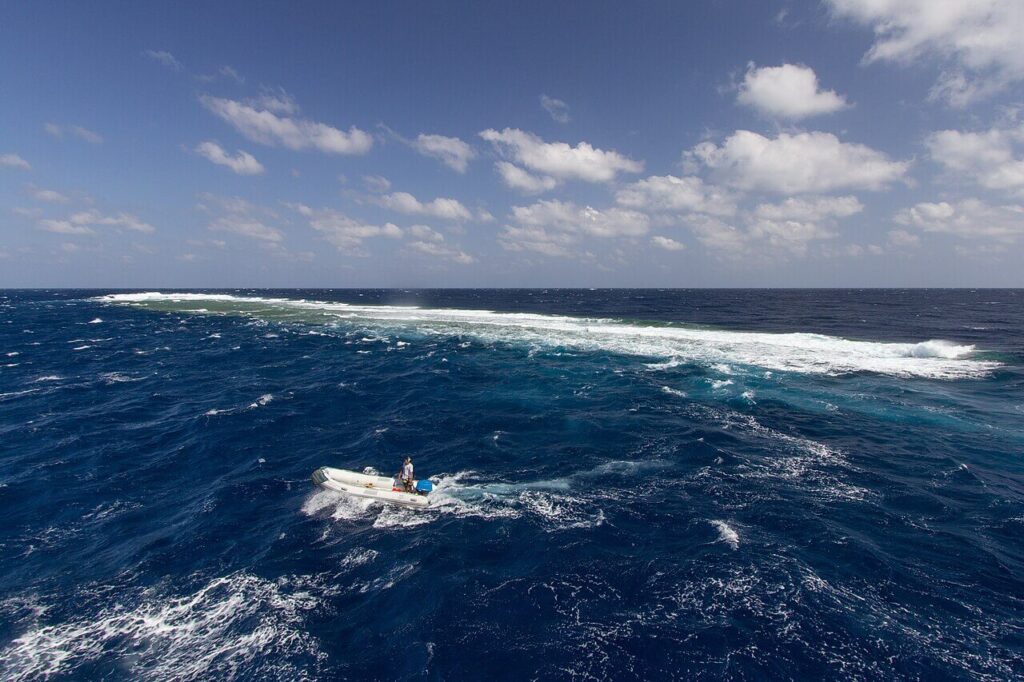
This is an offshore reef in open water, exposed to current, subject to swell, and dropping immediately to depth on both sides. The walls go from the surface to over 70 metres — there’s no gradual slope, no sandy bottom to check your depth on, just open blue below you.
So you seriously need to be able to manage your descents and ascents well.
That’s the experience: the reef on one side, the open ocean on the other, and the knowledge that anything could come out of that blue at any moment. On good days it does.
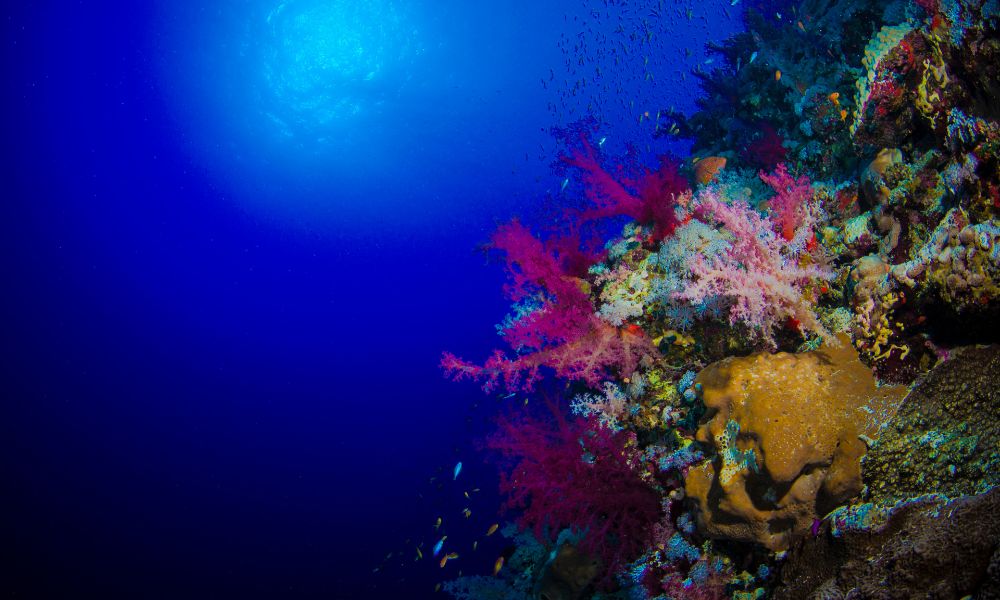
The soft coral coverage on both walls is exceptional — comparable to Shark Reef at Ras Mohammed, but with more variety at depth. Sea fans reach arm-length. Gorgonians cover every overhang.
The fish life is layered: anthias in the shallows, grouper mid-water, and the big stuff — tuna, barracuda, jacks — hunting in the current off the tips.
The Two Dive Sites: North and South Plateau
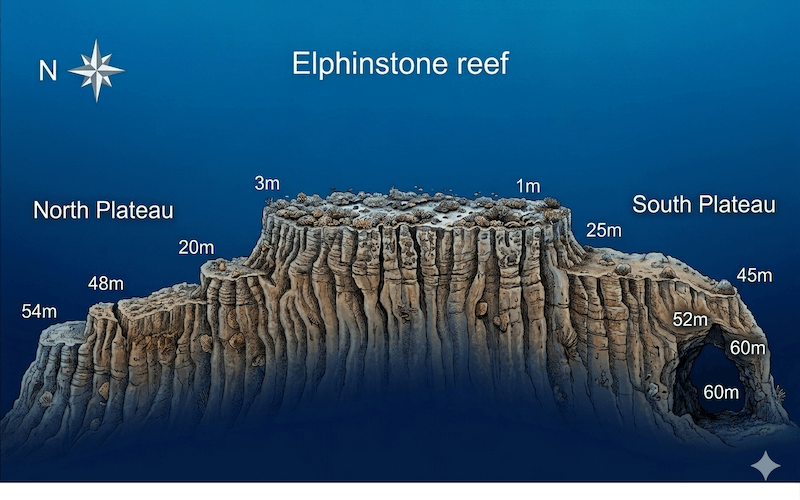
Elphinstone is typically dived at two entry points, each offering a different character.
North Plateau
The northern tip is the access point for most liveaboards. The plateau here sits at 18–25 metres and extends into a wide fin-shaped shelf before dropping off on both sides. This is where you spend your shallower time — working the plateau, watching the fish life, before moving to the western wall.
The western wall is where the soft corals are at their densest. Drop to 30–40 metres and work your way along with the gentle current. The visibility here is typically 20–25 metres, often more in the winter months. At the right time of year — October through December — this is also where the oceanic whitetips come in from the blue.
Oceanic whitetips are not reef sharks. They don’t circle. They approach, often directly, with the slow, deliberate confidence of a species that has no natural predators. Experienced divers handle this well. Nervous divers do not. Brief honestly before you get in.
South Plateau
The southern tip runs deeper and gets less diver traffic. The plateau here starts at around 28 metres and the walls plunge quickly. Hammerheads have been reliably spotted at depth off the southern tip, particularly in the early morning on an incoming current — the same pattern as Brothers Islands.
The south dive is a more demanding drift than the north — current is less predictable and conditions change faster. Most operators save the south plateau for experienced groups and run the north as the standard dive. If you’re comfortable in current and your guide offers the south, take it.
The Oceanic Whitetip — What to Expect
Oceanic whitetips (Carcharhinus longimanus) are the species that makes Elphinstone a pilgrimage site for serious divers from October to December. They arrive with the cooling water and they stay through the winter season.
Understanding how they behave changes the quality of the experience. These are not reef sharks cruising at a safe distance. Whitetips are investigative — they will approach you, often closely, and they don’t respond to the standard back-away-slowly protocol that works with most reef species. The correct response is to hold position, stay calm, and let the shark determine the interaction.
They are not aggressive without provocation, but “provocation” has a wider definition than most divers assume. Spearfishing near whitetips is dangerous. Erratic movement — panicked fin-kicking, surfacing fast, splashing — can trigger a more intense investigation. Calm, controlled diving is both safer and gives you a better encounter.
Responsible dive operators brief this properly. If yours doesn’t mention behaviour protocol before an Elphinstone dive in peak season, that’s a flag.
Important Thing To Note Before Diving With The Oceanics
I cannot recommend a well reviewed operator here, especially when diving with Oceanic White Tip sharks.
No point in lying to you guys, there has been multiple incidents and most of the time due to diver and guide error.
These sharks are super inquisitive and due to them being one of the top open ocean predators, they are curios and optimistic.
So it is important to understand good shark etiquette. Stay in a close group, especially if you leave the reef/wreck and head into open water and close to the surface. Anything flashy, erratic arm movements, skin reflecting from sun can all pull them in closer for a look.
Being with an operator and guide who understands and stresses shark etiquette is important to ensure a safe and memorable experience seeing these whitetips out in the open.
When to Dive Elphinstone Reef
October to December is the premier window. Oceanic whitetips are present, water temperature around 24–26°C, visibility at its best (25+ metres on good days). This is when you come specifically for the sharks.
January to March is still excellent — whitetips can still be present, hammerheads at depth are more common, and the reef life is fully active. Water temperature drops to around 22°C — a 5mm wetsuit is appropriate.
April to May is a transitional period — good diving conditions, less shark activity, but the reef and drift diving quality remain high.
June to September is the summer season — warm water (28°C+), competent diving, but the pelagic activity that makes Elphinstone special thins out significantly. If you’re choosing when to go specifically for Elphinstone, avoid summer.
How to Dive Elphinstone Reef
Elphinstone is liveaboard territory. The reef is roughly 60km southeast of Hurghada and 15km offshore from Marsa Alam — it’s an overnight passage destination from either departure port, and a natural stop on the southern Red Sea liveaboard itinerary.
Most south Red Sea liveaboards run a 7-night itinerary that includes Elphinstone alongside Brothers Islands, Daedalus Reef, and the St John’s/Rocky Island area. A boat that only offers two of these three is leaving the best of the south on the table.
Day trips from Marsa Alam are available but weather-dependent and limited to one or two dives.
For the full Elphinstone experience — diving both plateaus, dawn dive options, maximising your chance of the whitetip encounter — a liveaboard is the only sensible option.
Browse southern Red Sea liveaboards on Divebooker and filter for south itineraries.
Look specifically for boats that list Elphinstone, Brothers, and Daedalus on the schedule — that’s the Golden Triangle of southern Red Sea diving. Any decent south itinerary hits all three.
What Experience Level is Required to dive Elphinstone Reef?
Elphinstone is not a beginner site. The honest minimum:
- Advanced Open Water certification — depth, navigation, and buoyancy skills are all tested here
- Comfortable in open-water drift conditions — you may be in blue water with no visual reference below you
- 30–50 dives minimum — and ideally some current experience before you arrive
- Calm under pressure — not a personality judgment, but an honest safety consideration given the shark behaviour at this site
Divers who meet these criteria will have one of the best dives of their lives at Elphinstone. Divers who don’t will have a stressful experience and come back from a world-class site saying it wasn’t that special.
It can also get choppy on the surface, so being comfortable on the surface, and get head underwater quickly is essential.
Making sure you book a comfortable boat here matters, so check our our top Red Sea Liveaboard recommendations.
Elphinstone as Part of the Red Sea’s Golden Triangle
Brothers Islands, Elphinstone, and Daedalus Reef form the trio that serious Red Sea divers build south itineraries around. Each site has a different character:
Brothers Islands — two small islands with phenomenal walls, wreck diving (the Numidia and the Aida), and the most reliable oceanic whitetip encounters in the south Red Sea. The more dramatic of the three.
Elphinstone — the pure drift and shark experience. Less dramatic scenery than Brothers, but often better current action and a different quality of encounter with the whitetips.
Daedalus Reef — the most remote and the most rewarding if conditions are right. Hammerheads in numbers that can reach schooling behaviour. The least visited of the three, which makes the diving better.
A south itinerary that hits all three gives you three distinct experiences. Don’t let an operator sell you a “south itinerary” that skips one of them.
Frequently Asked Questions
Are there really oceanic whitetip sharks at Elphinstone?
Yes, reliably from October through December, and sometimes as early as September or as late as February depending on water temperature.
Oceanic whitetips are drawn to the reef by the cool, nutrient-rich upwellings around the offshore plateau. During peak season, encounters are very common — multiple sharks on a single dive is not unusual.
How dangerous is Elphinstone reef diving?
Elphinstone is an advanced site with real conditions — strong current, deep water, offshore location, and large sharks. It is not dangerous if you dive within your training and follow your guide’s briefing.
The risks are current-related for inexperienced divers and complacency-related for experienced ones. Brief properly, dive calmly, and Elphinstone is as safe as any advanced Red Sea site.
This being said – book with reliable liveaboards and research your operator properly first.
Is Elphinstone better than Brothers Islands?
Different, not better or worse. Brothers has the wrecks, the dramatic island scenery, and arguably the most intense whitetip encounters in the south Red Sea.
Elphinstone has cleaner drift conditions, two distinct plateau dives, and sometimes better visibility. Most serious Red Sea divers would say you need both. The good news is most south liveaboard itineraries include both sites.
What certifications do I need to dive Elphinstone?
Advanced Open Water as a minimum. The depth, current, and blue-water conditions exceed what Open Water certification prepares you for.
Some operators accept experienced Open Water divers with 50+ logged dives, but Advanced is the sensible threshold.
For the deeper hammerhead territory off the south plateau, 18 metres is not the ceiling you want.
And it is not always about depth or the certification “Advanced”.
It is; Can you hold your depth, can you get under safely, but not waste time on surface? Can you control your ascend? Can you dive a full 60 minutes? Because surfacing here earlier than everyone else becomes challenging when Oceanics are circling.