
The lesson
9 chapters · about 9 min
Chapter 1: Why ascents and descents matter
1 min
After 12 years and well over 10,000 hours underwater, I've seen every version of this. Divers who crash into the reef on descent. Divers who shoot past their safety stop and pop to the surface like a cork. Divers who can't get down at all. And divers who make it look effortless, because they've internalised the steps until they're automatic.
Manie Eksteen, PADI Staff Instructor
This lesson is about getting you into that last group.

An uncontrolled descent means you can't equalise properly, which risks ear barotrauma: damage that can sideline you for weeks or, in serious cases, permanently. You might drop onto coral that took decades to grow, or overshoot your planned depth and eat into your no-decompression limits before the dive has started.
An uncontrolled ascent is worse. As you rise, the nitrogen that dissolved into your tissues at depth starts coming out. Come up slowly and your body copes. Come up too fast and it forms bubbles in your bloodstream and tissues. That is decompression sickness (DCS), and it's not something you want to experience.
This isn't to scare you. Diving inside the limits is generally very safe, but it helps to understand the physics. Know the steps, and always dive within your comfort level.
Chapter 2: Before you go down: PADI's descent sequence
1 min
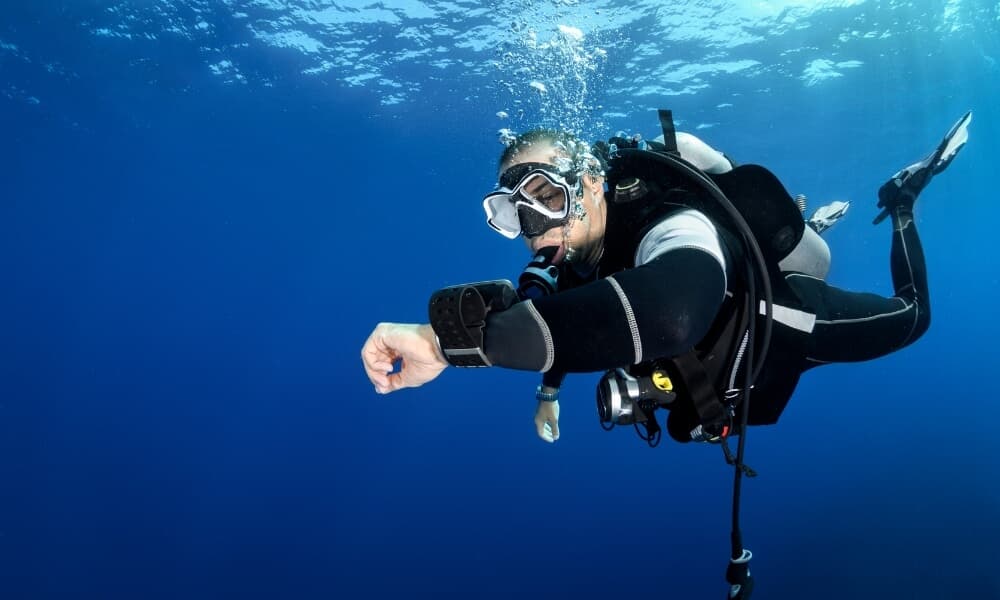
You've entered the water, whether by backwards roll, giant stride or shore entry. Before you go anywhere, run through PADI's descent sequence on the surface: S-O-R-T-E-D. It is not the buddy check, which is the BWRAF in the pre-dive safety check.
- Signal (S). Confirm with your buddy that you're both ready to descend.
- Orientation (O). Look in the direction you're heading. Know where you're going before you go down, and line yourself up with the rest of the group or guide.
- Regulator (R). Swap from snorkel to regulator.
- Time (T). Start your dive computer or timer now, not once you're at depth.
- Raise the BCD hose (E). Hold your BCD inflator hose up high and dump the air.
- Descend (D). Go down feet first and in control, ideally along a line or another reference, equalising early and often.
Stay vertical at this point: fins pointing down, body upright. If you go horizontal at the surface, the air trapped in your BCD won't drain properly and you'll fight the surface for longer than you need to. Then breathe out and let yourself sink.
Most divers underestimate the descent, but it sets you up for the rest of the dive. Getting it wrong can, in some cases, lead to underwater panic. What to do about panic underwater
Chapter 3: Go down in stages
1 min
Don't just fall to the bottom. Start the descent feet first and in control, ideally along a line or another reference, and go down in stages. It keeps you aware of where you are and gives your ears time to keep up.
Equalise early and often. Equalise before you descend, then every metre or so at the start, and keep doing it often. Never wait for pain. Every time you equalise your ears, puff a little air out of your nose into the mask.
Pause to check. Every so often, stop. Check your body position and buoyancy. Look at your buddy. Make sure you're still oriented in the right direction. Only then continue.
This rhythm isn't slow, it's controlled. There's a difference. You're not pausing because you have to; you're pausing because it makes everything easier from here on.
I follow this exact technique and I have been able to keep up with people swimming themselves silly to get down.
Difference? They are out of breath, I am in control and calm.
Manie Eksteen, PADI Staff Instructor
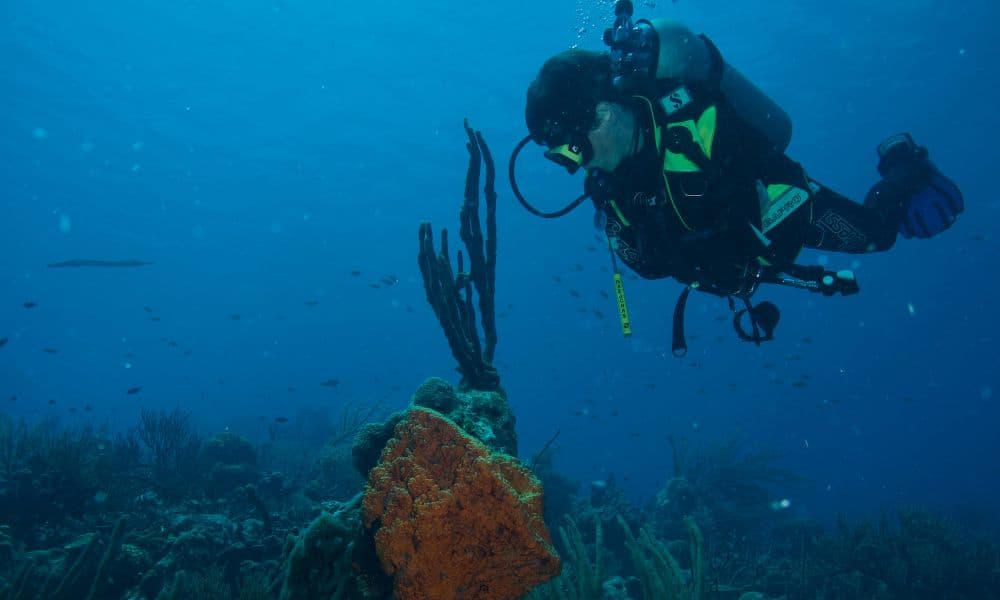
The skydive position. Once you've moved from vertical to horizontal, at around 5–8 metres, you're in a much better position to manage the rest of the descent. You can see your dive computer without contorting, watch your buddy naturally, and fin towards the dive site while still going down. When you arrive at the bottom, you're already in the trim position you'll use for the dive. You don't have to reset.
Chapter 4: Arrive neutral
1 min
As the bottom comes into view, add a little more air to your BCD. You want to arrive neutrally buoyant: not crashing in, and not hovering a metre above and kicking up silt.
Try this
- Keep breathing normally and watch what happens. You'll rise slightly as you breathe in and settle as you breathe out.
- That small rise and fall around one depth is neutral buoyancy, and where you want to be for the rest of the dive.
- From there, check your buddy, confirm your depth and start exploring.
Wetsuit compression. Around 5–8 metres your wetsuit starts to compress under the increasing pressure, and the buoyancy it was giving you starts to disappear. You'll get heavier. That's normal, but if you aren't ready for it you'll sink faster than you intended.
The fix is straightforward: as you start descending, add small bursts of air to your BCD. Short taps, not a long hold. You're compensating for what the wetsuit is losing, not trying to slow yourself with the BCD alone.
More on this in Mastering Scuba Diving Buoyancy.
Chapter 5: If you can't equalise
1 min
If you or your buddy can't equalise easily, stop and end the descent. Never force it. Gentle methods such as swallowing, moving your jaw or a gentle Valsalva (pinching your nose and blowing gently) are fine, but if they don't work, end the descent and signal your buddy.
Pain, dizziness (vertigo) or sudden hearing loss during a dive means abort. If symptoms persist, see a physician, and don't dive again until you have been checked. Never dive when you're congested.
A blocked ear that becomes a ruptured eardrum can keep you out of the water for months and cause permanent hearing damage. No dive is worth that. If your ears won't clear, calling the dive is the right call. Save your ears for another day.
If the group keeps going down: don't follow them down. Signal your buddy and your guide that you're ending the descent, and stay with your buddy.
Chapter 6: If your descent runs away
1 min
You're sinking faster than you want to, and it's accelerating. Here is one way to handle it.
First, kick. Use your fins to slow or stop the descent. Get yourself stationary: finning against gravity in a vertical position.
Once you've stopped or slowed significantly, then start adding air to your BCD. Don't reach for the BCD while you're still dropping fast; get stable first.
Once you've found neutral buoyancy at that depth, you'll likely be deeper than you planned. That's okay. Make your way back up using gentle kicks or breathing control, and release air from your BCD as you ascend: the air you added at depth will expand as you rise.
Use a reference whenever possible. Shore diving? Practise on the slope, where you have the bottom as a visual. Drift diving? The dive guide's line is your friend: grip it. It won't stop your descent, but it gives you a reference point that makes everything easier to manage.
Chapter 7: Start the ascent
1 min
Two things trigger an ascent: you've reached your turn pressure (the air reading at which the group starts heading back), or you've hit your planned turn point. Either way, your first job is communication. Always surface with at least 50 bar (about 725 psi) in the cylinder.
Signal your buddy with a clear, deliberate thumbs up and wait for their response. If you're with a guide, tell them too. Don't just start drifting upward.
Then find a reference. Wall dive? Use the wall. Line available? Use it. Open water with no visual reference? That's what your dive computer is for: watch your depth and ascent rate. Choosing one? See The Ultimate Guide to Choosing Your First Dive Computer.
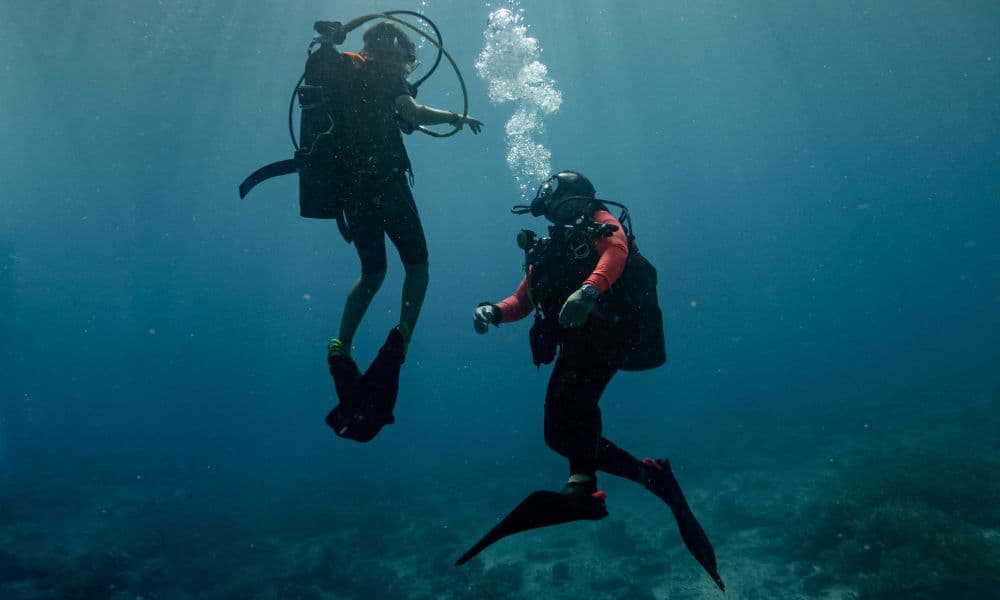
Mirror what you did on the way down. Ascend 5 metres, stop, check. At each pause, look at your buddy, check your depth, check your ascent rate and test your buoyancy.
Try this
- To test your buoyancy, breathe out fully and wait 1–2 seconds.
- If you drift down slightly, you're neutral at that depth. Good, keep going.
- If you don't move, or you keep rising after you exhale, vent a small amount of air from your BCD before you continue.
Have your deflator in your hand for the whole ascent. Not because you'll be constantly hitting it, but because when you need it, you need it immediately.
Chapter 8: Ascent rate and the safety stop
1 min
Come up no faster than 10 metres (about 30 feet) a minute, and take at least a minute for the last 6 metres. PADI's published maximum is 18 metres (60 feet) a minute, so agencies differ, and this lesson leads with the slower figure. Your computer's ascent-rate indicator rules, so follow its warnings.
Use your computer or depth gauge to hold the rate. Bubbles give you no measured rate.
The last 6 metres. This is where the pressure change is greatest. Be extra slow here and take at least a minute. The air in your BCD is expanding most rapidly, and if you're not actively managing it, you'll accelerate.
Hold your deflator ready. Breathe slowly and steadily. Never hold your breath: the expanding gas in your lungs needs to go somewhere, and if you hold it in, you risk pulmonary barotrauma. Even a few metres can injure you if you hold your breath.
Safety stop. Make a safety stop on every dive: 3 minutes at about 5 metres (15 feet), and make it 5 minutes after deeper or longer dives. This isn't optional on recreational dives. It is an added precaution that gives your body extra time to off-gas, and lets you check your gear, your buddy and your surroundings. It is not a decompression stop, and it never lets you exceed your limits.
Hold your depth with a reference if you have one. Wall, line, slope: use it. In open water it's harder, so your dive computer is your depth gauge. Watch it.
Chapter 9: If your ascent goes wrong
1 min
Uncontrolled ascent (shooting up). This is the scenario that makes instructors nervous. Vent air from your BCD straight away and spread your arms and legs to create drag. Keep breathing normally: never hold your breath, because the air in your lungs expands as you rise. Dealing with a runaway ascent is taught and practised in training with an instructor.
Once you've slowed and dumped the air, get horizontal, find neutral and reset your breathing. Then begin your ascent again, properly this time.
If you're close to the surface and don't have depth to play with, grab your buddy's or dive guide's hand. Any anchor is better than continuing to rise.
Signs to watch for after a dive. Don't plan to exceed your limits. If it happens, stop diving, tell your guide, and call for medical advice.
Watch for joint pain, unusual tiredness, itching or rash, numbness or tingling, dizziness, breathing difficulty, weakness or confusion. Symptoms usually appear within 12 hours but can take up to 36, and you should never dismiss them as tiredness or seasickness. If anything feels wrong, treat it as an emergency: get out of the water, call local emergency services, then call DAN (Divers Alert Network). Oxygen from a trained person is the standard first aid, and you don't go back underwater.
Remember
- Equalise before you descend, then every metre or so at the start, and keep doing it often. Never wait for pain.
- If you can't equalise easily, stop and end the descent. Never force it.
- Come up no faster than 10 m (about 30 ft) a minute, take at least a minute for the last 6 m, and let your computer's ascent-rate indicator rule.
- Never hold your breath, and be slowest in the last 6 metres.
- Make a safety stop on every dive: 3 minutes at about 5 m (15 ft), and 5 minutes after deeper or longer dives.
Questions
How fast should you descend when scuba diving?
Slowly enough to stay in control and keep up with your ears. Equalise before you descend, then every metre or so at the start, and keep doing it often. Never wait for pain. Start feet first, ideally along a line or another reference, and if you can't equalise easily, stop and end the descent.
The real problem isn't the speed itself, it's losing control of it. An uncontrolled descent accelerates as your wetsuit compresses and you get heavier, which is why you need to start compensating with BCD air before you feel you need to.
What is the safe ascent rate for scuba diving?
No faster than 10 metres (about 30 feet) per minute, and take at least a minute for the last 6 metres. PADI's published maximum is 18 metres (60 feet) per minute, so agencies differ, and this lesson leads with the slower figure.
Your computer's ascent-rate indicator rules, so follow its warnings and always dive with one. Bubbles give you no measured rate, so use your computer or depth gauge to hold the rate.
What happens if you ascend too fast in scuba diving?
The nitrogen that dissolved into your blood and tissues under pressure doesn't have time to off-gas safely. Instead of being exhaled normally, it forms bubbles. That's decompression sickness (DCS).
Symptoms range from joint pain and skin rashes to neurological problems and, in severe cases, paralysis. Fast ascents also risk pulmonary barotrauma: the air in your lungs expands faster than it can exit, which can rupture lung tissue and cause arterial gas embolism. Both conditions can be fatal.
This is why the safety stop at 5 metres matters, and why ascent rate isn't optional.
What should I do if I can't equalise on descent?
If you can't equalise easily, stop and end the descent. Never force it and never push through ear pain. Gentle methods such as swallowing, jaw movement or a gentle Valsalva (pinching your nose and blowing gently) are fine, but if they don't work, end the descent.
Pain, dizziness or sudden hearing loss means abort, and if symptoms persist, see a physician.
A blocked ear that becomes a ruptured eardrum can keep you out of the water for months and cause permanent hearing damage. No dive is worth that.