
Raja Ampat or Komodo: the short answer
Both are in Indonesia and both are best dived by liveaboard. They are different types of diving, and the wrong choice for your experience, interests or time can mean an expensive trip that does not deliver what you expected.
Raja Ampat is marine life at density, on an intact reef system. At Cape Kri the ichthyologist Gerry Allen counted 374 fish species on a single dive in 2012. The pace is gentler, the visibility consistently high, and the diving is defined by richness rather than dramatic action. The Raja Ampat liveaboard guide covers the boats, fees and season.
Komodo is about current. Castle Rock in peak flow. Batu Bolong with schooling fish stacked ten metres above the reef. Manta Alley with mantas working a cleaning station. Its best moments are current-driven and thermocline-dependent, so the water is colder, the conditions less predictable and the diving more technically demanding. Read the Komodo liveaboard planning guide first if you are considering it.
Marine life: what you see
Raja Ampat is diversity over drama. Macro life is the strength: pygmy seahorses, wobbegong sharks sleeping under table coral, ribbon eels, and mandarin fish at Arborek Jetty at dusk. Pelagic action happens, with giant trevally, barracuda schools and occasional hammerheads in the north, but you go for the reef, not for the sharks.
Komodo is action over density. Mantas are the headline, and Manta Alley in season delivers: oceanic mantas in large groups, often stationary on cleaning stations, close enough to observe properly. Thresher sharks are occasionally encountered on early morning dives, hammerheads appear at some northern sites, and the cold upwelling sites produce dense schooling fish that the current stacks vertically. It also has strong macro: Cannibal Rock is blanketed in nudibranchs, flatworms and other small critters.
Raja Ampat wins on diversity and reef health. Komodo wins on dramatic encounters and current-driven fish concentration.
Getting there
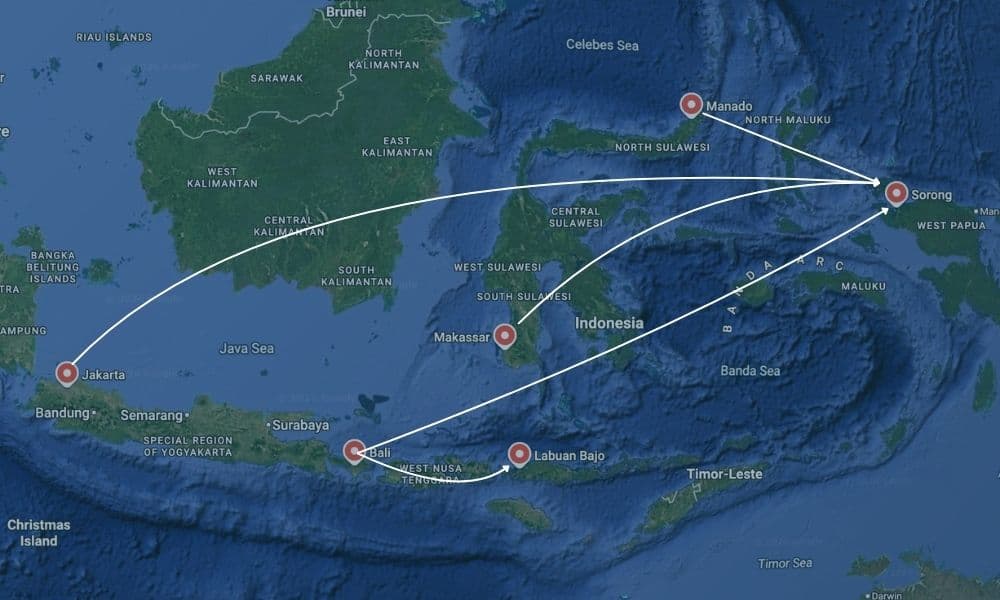
Raja Ampat is harder to reach. You fly into Sorong (SOQ) via Jakarta, Makassar or Manado, with no international connections, and the journey from most origins is 24–30+ hours door to door. The best sites are spread across a wide archipelago and need a liveaboard to cover properly, since day trips from a land base cover one zone at most.
Komodo is more accessible. Labuan Bajo (LBJ) has frequent connections from Bali, a 1.5-hour flight, and day trips from there cover many of the main sites competently. A liveaboard is still the best way to dive it seriously, but it is not mandatory the way it is in Raja Ampat.
If logistics are a constraint, such as limited leave, complex routing or a first time in Indonesia, Komodo is easier to plan around. Its routing from Bali is also marginally cheaper and simpler than the flights to Sorong.
Experience you need
Raja Ampat: most operators require Advanced Open Water and 30–50 logged dives. The Dampier Strait sites involve drift diving in variable current, but the overall character is gentler than Komodo, and many sites are accessible to competent recreational divers without being technically demanding.
Komodo: Advanced Open Water for the pinnacle sites. The currents at Castle Rock, Shotgun and Batu Bolong are powerful, fast and variable, and upwellings and downwellings at southern sites can be severe. It is not a first-liveaboard-ever destination for divers without meaningful current experience. If your first liveaboard is in planning, its calmer reef sites are manageable, but the headline dives are not.
What each costs on top of the boat
Budget liveaboards in both destinations start around $250–300 a day per person. The mandatory add-ons differ (amounts as of May 2026):
- Raja Ampat: the entry fee (IDR 1,000,000, about USD 60, as of 17 September 2026, rajaampatbiodiversity.com) plus the park fees (200–320 USD). Total mandatory add-on: about 260–380 USD per person per trip. The marine-park charge changed in August 2026, so confirm the current park fees with the boat.
- Komodo: the national park fee (200–250 USD), harbour fees (60–80 USD) and a possible fuel surcharge (200–400 USD on some operators). Total mandatory add-on: 260–730 USD, depending on the boat and market conditions.
The fuel surcharge is the trap. On operators like Pindito it can add significantly to the quoted daily rate, so confirm before signing whether it is fixed or market-dependent. Both destinations also need flights to Indonesia.
Who should go where
| Choose Raja Ampat if you | Choose Komodo if you |
|---|---|
| Are primarily a reef diver who wants marine diversity | Want dramatic current diving and do not mind cold thermoclines |
| Want an intact coral ecosystem | Put manta encounters first |
| Are interested in macro | Want a simpler way into Indonesia |
| Want something that looks unlike anywhere else | Want land and diving on the same trip |
| Are comfortable with the more complex routing into Sorong | Have already dived some current and are ready for a step up |
Do both if you are in Indonesia for more than ten days and have the budget. The two destinations are complementary: one delivers what the other does not.
For each place on its own, see the Raja Ampat diving guide and the Komodo diving guide. For the boats, see the best Raja Ampat liveaboards of 2026 and the Komodo liveaboard planning guide.
Questions
Which is better for diving: Raja Ampat or Komodo?
Raja Ampat is better for reef richness and macro life. Komodo is better for strong current, dramatic manta encounters and cold-water fish density.
Is Raja Ampat harder to dive than Komodo?
Komodo's headline dives are technically more demanding: Castle Rock, Shotgun and Batu Bolong involve serious current that needs solid drift diving experience. Many Raja Ampat sites are gentler, though the Dampier Strait also has strong currents. Overall, it presents more consistent technical challenge across its best sites.
Can I do both Raja Ampat and Komodo on one trip?
Yes, but usually as two separate liveaboard trips from different ports: Sorong for Raja Ampat and Labuan Bajo for Komodo. The practical route is to fly into Bali, on to Labuan Bajo, back to Bali, then via Jakarta or Makassar to Sorong. It is a significant routing commitment, but a rewarding combination.
Which is easier to get to: Raja Ampat or Komodo?
Komodo. Labuan Bajo has direct connections from Bali, at 1.5 hours. Raja Ampat needs a flight into Sorong via Jakarta, Makassar or Manado, typically 24–30+ hours from international origins.
Is Raja Ampat or Komodo better for manta rays?
Komodo, if mantas are your priority. Manta Alley and Manta Point (Karang Makassar) are dedicated manta sites, and in our guides Manta Alley peaks from July to September, though some sources put it from January to March. Raja Ampat also has mantas, at Manta Sandy and Manta Ridge, best from November to March.