
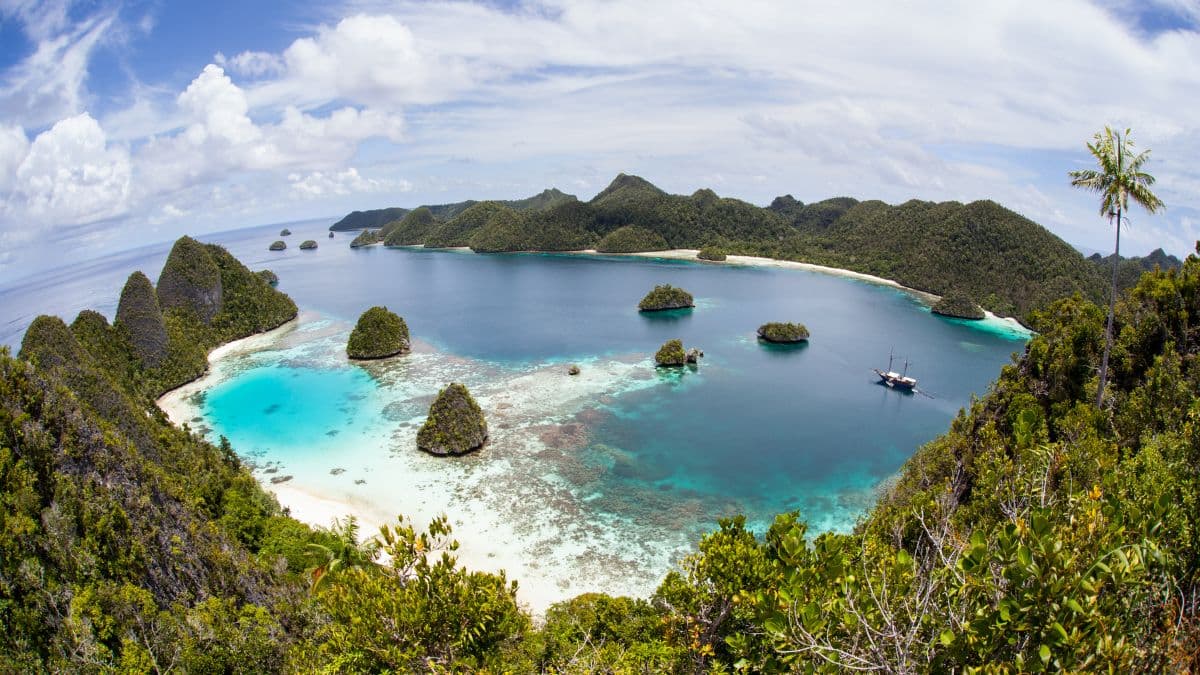
Why a liveaboard suits Raja Ampat
Most dive destinations can be covered from a resort. Raja Ampat cannot, not properly. The archipelago is so vast, and the best sites so spread out, that a land base means spending your best dive time in transit. That is why serious divers think about the boat first and the logistics second.
I've planned multiple client trips through Raja Ampat and know exactly where the surprises hide, including in the costs.
Manie Eksteen, PADI Staff Instructor
Cape Kri, a single site in the Dampier Strait, holds the world record for fish species counted on one dive: 374. A liveaboard puts you on the water, moving between sites, with no transfer time and no dependence on whether a resort speedboat is running that day. You wake up on the site, dive it at dawn before other boats arrive, and the boat moves on while you eat and nap. The liveaboard vs resort comparison sets out the trade-offs.
Ready to look at boats?
Three areas a liveaboard links
The sites cluster across three main areas: the Dampier Strait in the north, the Four Kings islands, and the more remote southern reaches around Misool. Each is a solid day's boat ride from Sorong. A land-based operator running day trips can realistically cover one area. A liveaboard covers all three.
The Dampier Strait holds Cape Kri, Sardine Reef, Blue Magic and Manta Sandy, and mantas gather at Manta Sandy and Manta Ridge throughout the season. Further south, Misool is quieter and more remote, with dense soft coral.
Best time: October to April
The season runs from October to April. This is the dry season, when winds are settled, visibility is consistently high (often 20–30 m) and the full range of dive sites is accessible. Water is 27–30 °C year-round, so a 3 mm wetsuit is typically all you need.
Peak season is November to March. For mantas, this is when Manta Sandy and Manta Ridge reliably produce the best congregations. Schools of fish are at their densest in the Dampier Strait, and visibility tends to peak in January and February.
The wet season trade-off
May to September is the wet season. The diving does not stop entirely, and many operators run reduced schedules, but wind and swell make some sites inaccessible and passage between areas more uncomfortable. Some remote outer sites close completely. July and August are the stormiest months, and many liveaboards suspend operations. For a first Raja Ampat trip, book October to April.
Raja Ampat is also far less crowded than Komodo or the Maldives. Even in peak season you share Cape Kri with a handful of boats at most.
Getting to Sorong
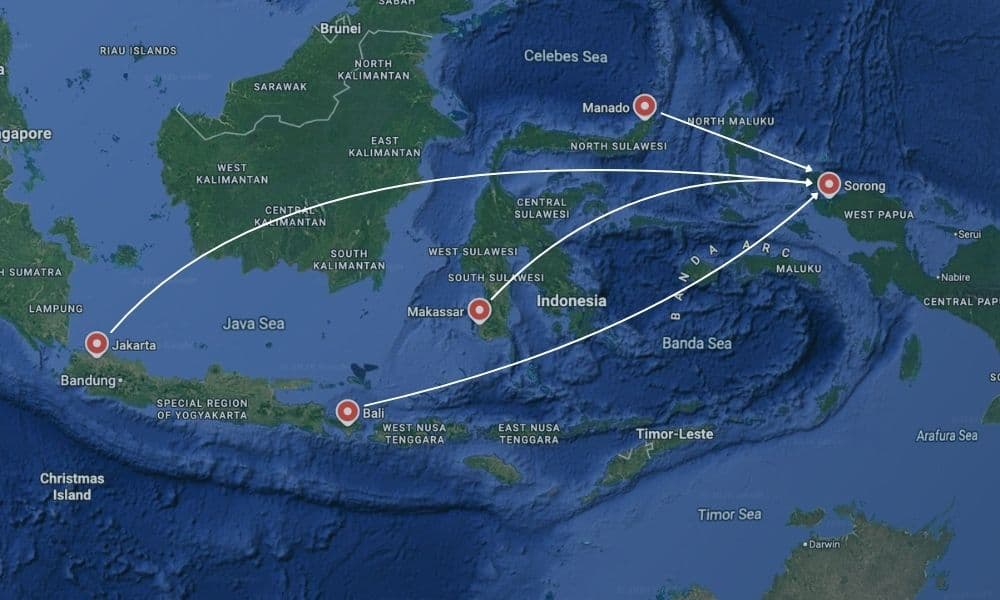
All Raja Ampat liveaboards leave from Sorong, on the western tip of Papua (airport code SOQ). There are no direct international flights, so you connect domestically, almost always via Jakarta, Makassar, Bali or Manado. Jakarta to Sorong is a 4.5-hour flight. From Europe, the Middle East or Australia, expect a minimum of 24–30 hours door to door, which is a long chain for baggage to go astray.
Build in at least one buffer night in Sorong before departure. Most boats leave in the early afternoon of day 1, so if your inbound flight is cancelled or delayed, a buffer night means missing your hotel, not your boat. Sorong is not a destination in itself, but it has decent accommodation near the port and airport, and one extra night is cheap insurance on a trip that has cost you real money.
What a Raja Ampat liveaboard costs
The per-day rate you see listed is not the full cost. Most liveaboards include accommodation, full board (meals, tea, coffee, soft drinks), tanks, weights, a dive guide and transfers to and from Sorong airport. Some include nitrox; most list it as a surcharge.
Every diver must also pay two fees that are not in the boat rate, and nitrox is extra on most boats. The entry fee is as of 17 September 2026, and the other amounts are as of May 2026:
| Fee | Amount | Notes |
|---|---|---|
| Raja Ampat entry fee | IDR 1,000,000 per person (roughly USD 60) | Paid once, not per day, online in advance through the official tourist registration system. Source: rajaampatbiodiversity.com, reviewed 17 September 2026 |
| Park and port fees | 200–320 USD per person | Depends on the operator and itinerary, and is paid on board or in advance. Some operators roll it into the quoted daily rate, so confirm before booking. The marine-park charge changed in August 2026 and the source prints no amount, so ask the boat for the current figure |
| Nitrox | Typically 100–150 USD per week | Most boats charge it as a surcharge, and a few have no nitrox at all |
Budget about 260–380 USD per person on top of your cabin rate for the entry fee and the park fees. That changes your real cost per day.
Experience you need
Raja Ampat is not a beginner destination. Currents in the Dampier Strait can be strong and unpredictable, and many of the best sites need solid ascents and descents and the ability to manage drift conditions calmly. Most operators require Advanced Open Water and 30–50 logged dives before boarding.
Sites like Manta Ridge and Blue Magic have current that can pick up fast, and a diver without drift experience will struggle, stress their guide and may miss dives. If Raja Ampat is on your radar for a first liveaboard trip, consider a week of drift diving elsewhere first. The Red Sea can be a good introduction.
Boats to compare
Over 50 boats operate in Raja Ampat on Divebooker, from budget phinisi vessels under $300 a day to luxury boats pushing $600. These are not rankings. They are the boats to evaluate first, across three tiers: budget boats start around USD 300, mid-range runs USD 350–500 and luxury starts above USD 500. Prices and discounts are Divebooker's as of May 2026.
| Boat | From, per day | Guests | What stands out |
|---|---|---|---|
| Neptune One (opens Divebooker) | USD 302 | 16, in 8 cabins | Built 2017, renovated 2023. Free Wi-Fi, nitrox at a surcharge |
| Mermaid II (opens Divebooker) | USD 305 | 18, in 10 cabins | A mix of deluxe main-deck and budget lower-deck cabins. Managed by Mermaid Liveaboards |
| Amaya Explorer (opens Divebooker) | USD 330 | 16, in 8 cabins | Built 2018, with 4 dives a day included, sea kayaks and paddleboards. No nitrox on board, so confirm before booking if you need it |
| Sea Safari 8 (opens Divebooker) | USD 428 | 26, in 12 cabins | The largest boat here. An itinerary covering the Dampier Strait, Penemu, Kri and The Passage. Nitrox at a surcharge |
| Dancing Wind (opens Divebooker) | USD 590 (25% off) | 20, in 8 cabins | A 45 m ironwood hull, built 2018. Beers and unlimited beverages included |
Our ranked Raja Ampat liveaboards compare more boats. Weighing up the destinations first? Raja Ampat vs Komodo compares both directly.
Questions
How much do Raja Ampat liveaboards cost?
Budget boats start from around USD 300 a day, mid-range runs USD 350–500 and luxury goes from USD 500 up (as of May 2026). That is the cabin rate only. Add roughly USD 260–380 per person for the Raja Ampat entry fee (IDR 1,000,000, about USD 60, as of 17 September 2026) and the park fees (200–320 USD as boats listed them in May 2026). Nitrox, gear rental and crew tips are extra on most boats.
How do I get to Raja Ampat for a liveaboard?
All liveaboards depart from Sorong (SOQ) in West Papua, Indonesia. There are no international flights to Sorong, so you connect via Jakarta, Makassar or Manado. Allow 24–30 hours door to door from most origins, and build in a buffer night in Sorong to absorb any domestic flight delays.
What experience level do I need for Raja Ampat?
Most operators require Advanced Open Water and a minimum of 30–50 logged dives. Several Dampier Strait sites have strong, variable currents, so you need to be comfortable with drift diving and controlled descents before boarding. Raja Ampat is not recommended as a first liveaboard destination for newer divers.
What is the best time for diving Raja Ampat?
October to April, the dry season. The water is calmer, visibility is consistently 20–30 m and the full range of sites is accessible. Peak season is November to March. The wet season (May to September) brings stronger winds and reduced site access on some itineraries.
Is nitrox available on Raja Ampat liveaboards?
Most boats offer nitrox as a surcharge, typically 100–150 USD per week. Not all boats have it: Amaya Explorer, for example, does not. If you dive on enriched air, confirm availability before booking.
Do I need to book Raja Ampat liveaboards far in advance?
Yes. The most popular boats fill 6–12 months ahead, particularly in the November to February peak window. Budget boats and shoulder-season departures (October, March and April) are more flexible. For a peak departure on a well-reviewed boat, treat it like a flight booking: earlier is better.