
Introduction into the Pre-dive safety check
The transition from the surface to the underwater world is a moment of profound excitement. But let’s be honest: it’s also the time when you are most reliant on your equipment and why a pre-dive safety check is so important!
The best divers know that safety starts long before you hit the water. What if I told you that a simple five-point step, taking only five minutes, could completely save your dive—and possibly your life?
Welcome to the Pre-Dive Safety Check. In this Dive Academy lesson, we are moving beyond the basics. We are going to build your foundation by exploring the globally recognized BWRAF method.
This systematic protocol is your first line of defense against equipment malfunctions, setup errors, and the most common diver mistakes—like rolling backward off the boat only to realize your air is turned off!
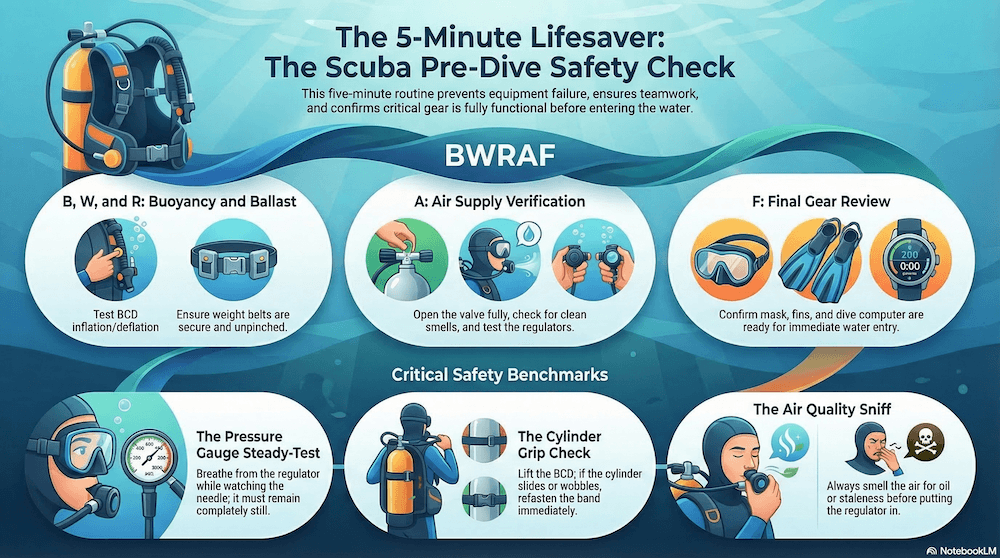
What is the pre-dive safety Check?
The Philosophy of Preparation
Most diving accidents aren’t caused by a single catastrophic event; they are a sequence of small, overlooked issues that compound underwater.
The purpose of the pre-dive check is to:
- Confirm that your equipment is functioning properly
- Catch setup errors before you enter the water
- Make sure you and your buddy are physically and mentally ready
- Improve teamwork and communication
- Prevent common mistakes that can ruin the dive before it even starts
We use the acronym BWRAF (Begin With Review And Friend, or Burger With Relish And Fries—pick your favorite!). Regardless of what you call it, this check happens in two phases: during your gear setup, and just before you enter the water.
It should NOT be skipped and should always be in the same exact order to build the muscle memory.
DAN (Divers alert Network) emphasize the value of predive checks, and DAN has specifically linked complacency and skipped buddy checks to preventable incidents!
BWRAF Checks
B – Buoyancy Control Device (BCD)
This step is about ensuring your BCD is working properly and ready for the dive.
Quick BCD checklist
- inflates fully
- holds air
- deflates properly
- dump valves are secure
- bladder is not trapped or twisted
- Straps/buckles secure and works
Connect your inflator hose and inflate the BCD all the way. Check that it holds air without leaking. Pro Tip: If you dive with a backplate and harness system, check that your bladder actually inflates equally on both sides. Sometimes, the bladder gets trapped between the cylinder and the backplate.
Leave it inflated and inspect all the dump valves on your shoulders and lower back. You can even spray the plugs with water to check for bubbling.
Inflate your BCD fully again. When you're geared up and sitting on a rocking boat, your dump valves can easily get tucked under your weight belt or caught in your straps.
If you try to inflate and the air immediately dumps out the shoulder, you need to adjust your gear. You should also have some air in the BCD to start with.
W – Weights
Weight systems are a frequent source of trouble. Make sure you know how much you need prior, it fits and that the buckle/integrated buckles work!
Quick weights checklist:
- correct amount of weight
- belt or pockets secure
- release works properly
- buddy knows how your system releases
Pull a reference from your logbook. If you are shifting from a 3mm suit in the Red Sea to a 5mm suit in Raja Ampat, your weighting will change drastically. Allocate the right amount of weight and physically check the belt or integrated pouches.
Secure your weights before you put your BCD on (unless using integrated pockets). When you close your weight belt buckle, make sure the actual belt fabric isn't pinched inside the clasp—if it is, it will pop open underwater.
Pro Tip for Cold Water Divers: If you dive in a thick 5mm to 10mm wetsuit, the neoprene will compress as you go deeper. You must reach down and re-tighten your weight belt at the bottom. If you don't, the loose belt will slide around your waist, completely messing up your trim and weight distribution.
R – Releases
This covers all buckles, straps, clips, and the cylinder band.
Quick releases checklist:
- all clips and buckles work
- shoulder and waist straps are even
- nothing is twisted
- cylinder band is tight
- no hoses are trapped under straps
When renting equipment from a dive shop, do not wait until you are on the boat to check the BCD clips. I've seen people drive two hours to a dive site only to find a broken shoulder buckle, leaving them sitting on the boat chatting with the captain while everyone else dives. Put the BCD on at the shop. Check the cummerbund, ensure it fits, and test every clip.
Make sure your shoulder straps are equally tightened. If one is cranked down and the other is loose, your tank will shift to one side, causing massive buoyancy issues. Finally, check your cylinder band. Fasten it, take two fingers, and try to lift the BCD up and down on the tank. If it slides even a millimeter, it’s too loose. Re-fasten it, or risk your tank slipping out at 20 meters.
A – Air
This is the most critical technical step! Do not just glance at your gauge.
Quick air checklist:
- cylinder fully open
- tank pressure confirmed
- primary regulator purges and breathes properly
- alternate air source works
- air smells normal
- SPG needle stays steady while breathing
- alternate is clipped in the front triangle
- Mouthpieces are good.
Slowly open the cylinder valve all the way. (Note: Modern protocols advise against turning it a bit back to prevent accidental valve restriction at depth, but I still do and recommend it recreationally). Grab your pressure gauge (SPG) to confirm the tank is full. Take your primary second stage, give it a quick purge, and then take a few deep breaths while watching the needle. If the needle fluctuates or drops, your air is restricted or not fully turned on.
Pro Tip: Smell the air. If it smells stale or oily, do not dive with it. Also, inspect the rubber mouthpiece. A tiny tear on the top will cause you to swallow seawater with every breath. Repeat this exact process for your alternate air source (octopus) and secure it in the "golden triangle" (between your chin and lower ribcage).
Make sure to check your mouthpieces! Check the top part by your lip too!
Now you have already checked everything is working. So now just take your primary, your gauge and take a deep few breaths while making sure your needle on the SPG does not fluctuate.
F – Final Buddy Review and Check
This is the most critical technical step! Do not just glance at your gauge.
Quick Checklist:
- your mask is ready & defogged. Here is how to defog it correctly!
- fins are in place
- your dive computer is on
- the gas mix is correct if applicable
- accessories are clipped off properly
- nothing important has been left behind
- you and your buddy are both ready to enter
Once your gear is set up on the dock or deck, turn the air completely off and purge the regulators. Why? So that if you try to take a breath later, you will feel a hard suction. This prevents the dangerous mistake of jumping in with a partially opened valve. Lay the gear down safely: put your mask in a fin pocket, place fins on top of the BCD, and secure your dive computer to your wrist to prevent expensive gear from being stepped on.
This is the buddy review. Do you have your fins? Is your mask defogged? Is your computer turned on and set to the right gas mix? Is your camera clipped on? Is your buddy okay and are you ready for the entry.
Take a second here to mentally prepare and make sure you are not rushed. No dive is worth your life, so make sure you take the time to get comfortable.
Conclusion on the Pre-dive safety Check
The pre-dive safety check is not a sign of a beginner; it is the hallmark of a disciplined diver.
Silence is the enemy of safety. Master the BWRAF, communicate with your buddy, and ensure the only surprises you encounter underwater are incredible marine life.
In most underwater panic events, it started well before and most of the time can be prevented by doing your checks.
You can learn more here: Scuba Diving Panic: What to Do, How to Help AND how to Prevent It!
Keep practicing, and start exploring today.
Next Lesson Mastering Scuba Diving Buoyancy