
Introduction into Scuba Diving Panic
Panic is one of the leading causes of death in recreational scuba diving. Not equipment failure. Not sharks. Panic.
Surveys suggest that more than half of all certified divers have experienced at least one panic or near-panic episode underwater. The death certificate often reads drowning — but in many of those cases, the diver had a full tank of air, working equipment, and a weight belt still buckled on. The equipment didn’t fail. The mind did.
I’ve personally rescued and assisted in more situations involving diver panic than I’d like to admit. Twelve years as a PADI Staff Instructor, cave diver, and technical diver gives you a very specific kind of education — the kind that happens at 20 metres when something goes wrong and you have seconds to make the right call. Over that time, I’ve developed a very clear picture of how panic starts, how it unfolds, and what actually works when you’re in the middle of it.
This lesson is built around a real incident — footage of a diver at 15 metres who, within seconds of the guide signalling the ascent, had her mask off, regulator out, and was bolting for the surface. The clip went viral for a reason. Most divers watched it and felt something uncomfortable — because somewhere in it, they recognised themselves, or someone they’ve dived with.
We’re going to break it down fully. Not just what to do as a rescuer — but what to do as a bystander, what happens to a diver’s body and brain during a panic event, what the real risks are after a rapid ascent, and most importantly, what you can start doing on your next dive to make sure this never happens to you or someone in your group.
This is a long one. It’s worth reading in full.
What Actually Happens During a Panic
Before we get into what to do, you need to understand what’s happening inside the diver’s head — because it completely changes how you respond.
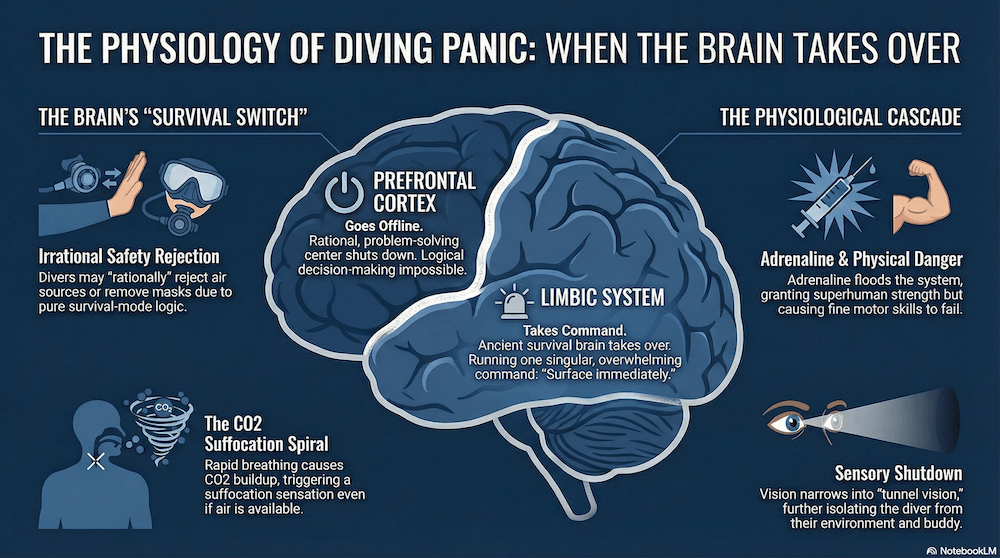
Panic is not a choice. It is a physiological event. When a diver crosses the threshold from stress into panic, the prefrontal cortex — the rational, problem-solving part of the brain — effectively goes offline. The limbic system takes over. This is your ancient, survival-wired brain, and it has one instruction: escape.
This is why a panicking diver will rip out a regulator that is delivering air. It is why they reject an alternate air source even when they are out of air. It is why they tear off a mask that is allowing them to see. None of these things make rational sense. But the panicking brain is not operating in rational mode — it is in pure survival mode, and the only command it is running is surface, surface, surface.
Understanding this is critical for anyone trying to help. You are not dealing with a diver who has made a bad decision. You are dealing with someone whose decision-making capacity has temporarily shut down. The approach changes completely when you understand that.
The Panic Spiral
In most cases — and almost certainly in the incident that sparked this article — panic doesn’t arrive without warning. It builds through a spiral that looks like this:
A stressor appears → breathing rate increases → air consumption accelerates → available air drops → anxiety intensifies → breathing gets faster → air drops further → rational thinking degrades → full panic.
By the time the mask comes off, the spiral has usually been running for minutes. The final trigger — low air, a foggy mask, losing sight of the guide — is rarely the cause. It’s the last domino. The real cause is everything that came before it.
What the Body Does during a scuba diving panic
- Breathing becomes rapid and shallow, causing carbon dioxide to build up
- CO2 buildup intensifies the sensation of suffocation — even if air is available
- Adrenaline floods the system, producing the sensation of superhuman strength (which is why a panicking diver can be genuinely dangerous to approach)
- Vision narrows — tunnel vision is common
- Fine motor skills degrade — this is why they fumble with equipment they could operate perfectly when calm
- The urge to surface becomes overwhelming and overrides all other input
What Triggers Panic — The Full Picture
Most articles will tell you a scuba diving panic is caused by running out of air. That’s the end of the story, not the beginning.
Here is the full list of triggers I’ve seen either directly cause, or contribute to, a panic event:
Before the dive even starts:
- Feeling pressured into a dive you’re not comfortable with — by a partner, a group, a guide, or your own ego
- Being hungover, underslept, or physically unwell
- Diving with a buddy you don’t know and haven’t briefed properly
- Using new gear that hasn’t been tested in confined water first
- A pre-dive safety check that was rushed or skipped
Here is a full breakdown on how to do a proper Pre-Dive Safety Check – step by step.
During the descent:
- Being overweighted — fighting to stay off the bottom burns air and mental bandwidth simultaneously
- Being underweighted — fighting to stay down creates the same problem from the other direction
- Equalisation pain that escalates into panic about ear damage
- Rushing the descent and arriving at depth disoriented, breathing fast, and already behind
Check out our full guide on Scuba Diving Ascents and descents
During the dive:
- Cold, green, low-visibility water — the environment feels hostile in a way that warm, clear water doesn’t
- Foggy or flooded mask — distorted vision is an incredibly powerful stress trigger
- Losing sight of the guide or the group
- Overexertion — swimming against current, chasing marine life, covering too much ground
- Watching other divers and feeling like you’re the slowest, the worst, the most out of control
- Equipment malfunction — even something minor like a free-flowing regulator or a loose fin strap can cascade into panic if the diver doesn’t have the skills to manage it calmly
- Low air — especially when it arrives faster than expected
The weighting issue deserves specific mention. On a liveaboard or with a new dive operator, the guide will often estimate your weight if you don't know it yourself.
In my experience, when a guide is guessing, they'll give you more rather than less — because getting a diver down is easier to manage than dealing with someone who can't descend on the surface.
The result is a diver who is overweighted, fighting their buoyancy, burning through air, and starting the spiral before they've even reached depth. This is not the guide's fault. It's a system problem — and the solution is knowing your own weight before you get on the boat.
Part One: What to Do as the Rescuer
This section covers the response from the perspective of the dive guide or rescuer.
Step 1 — Identify Distress Early
The earlier you identify a diver in distress, the more options you have. By the time the mask is off, you’re managing an emergency. Before that point, you might be able to interrupt the spiral entirely with something as simple as eye contact and a calm hand signal.
Watch for:
- Rapid bubble stream — no pauses between exhale and inhale. A calm diver has a rhythm. A stressed diver’s bubbles are continuous.
- Erratic fin kicks or arm movement — a diver fighting their buoyancy looks completely different from a diver in control
- Eyes — wide, darting, not making contact. A calm diver looks around curiously. A stressed diver has the look of someone trying to find a way out.
- Positioning — a stressed diver often drifts above the group, instinctively moving toward the surface even before conscious panic sets in
- Abandoning proper body position — legs dropping, hands out, head up
If you catch it at this stage, approach calmly. Establish eye contact. Gently signal to stop. Breathe slowly and exaggeratedly — model the breathing you want them to do.
A firm, reassuring hand on the shoulder (not anywhere that can trigger stress) is often enough to interrupt the spiral before it reaches full panic.
Step 2 — If They’re Already in Full Scuba Diving Panic
Full scuba diving panic is characterised by: mask off, regulator out, rapid or uncontrolled ascent, loss of awareness of surroundings. At this stage, the rational brain is gone.
Your safety is the first priority. Always. A panicking diver in the grip of adrenaline has genuine strength — experienced rescuers have been injured by divers half their size. Never rush in without assessing your own position first.
The Approach during a scuba diving panic
Approach with caution, staying aware of flailing limbs. Your goal is to get control of their BCD — specifically the main chest buckle — and manage the ascent rate. How you get there depends on the specific situation, your training level, and the diver's state.
There is no single universal approach — this is why rescue diver training matters. The scenarios you practice give you options. Without that training, you're improvising.
The alternate air source
Offer your alternate air source. Keep it visible, keep it extended and try your best to give it to them. If they take it — great. If they hard reject it, don't force it. A panicking diver who rejects air is not being irrational — their brain is not processing the offer correctly.
Forcing a regulator on someone in full panic can make the situation worse. Get them to the surface. Deal with air there.
In a dive where a ceiling is present (overhead environments or decompression) the methods change.
The ascent
Once you have hold of their BCD, focus on slowing the ascent rate as much as you practically can. Flare your legs. Exhale continuously — lung overexpansion injury is a real risk for the rescuer too, not just the victim. You cannot stop a panicking diver from ascending, but you can control the rate, which matters for what happens next.
PRO TIP
As you ascend together, leave their BCD alone at first. Don't touch the inflator, don't dump air from it. Focus entirely on keeping yourself deflated & heavy.
Here's why: if contact is broken during the ascent, the air in their BCD expands as they rise, which continues to carry them upward. You remain neutral or slightly negative and stay where you are. She goes up — you stay put. That is the outcome you want. If you inflate your own BCD and lose contact, you both go up uncontrolled. Keep yourself deflated, and you retain the ability to manage the situation.
Step 3 — On the Surface after a scuba diving panic.
When you reach the surface after a scuba diving panic:
Inflate their BCD — enough to keep them positively buoyant, but not fully inflated. An over-inflated BCD can restrict breathing, which is the last thing you want on a panicking diver who already has compromised breathing.
Drop their weights — if it’s safe to do so. Check there are no divers ascending below you before you ditch weights. A dropped weight belt at depth is a serious hazard for anyone below.
Keep your own BCD deflated. A panicking diver on the surface can still be unpredictable. If they lunge at you and you’re inflated, they can use you as a float and push you under. If you’re deflated and they grab you, you can go under the surface, break contact, and surface behind them — while they remain floating because their BCD is inflated. I learned this the hard way. Stay deflated until the situation is fully under control.
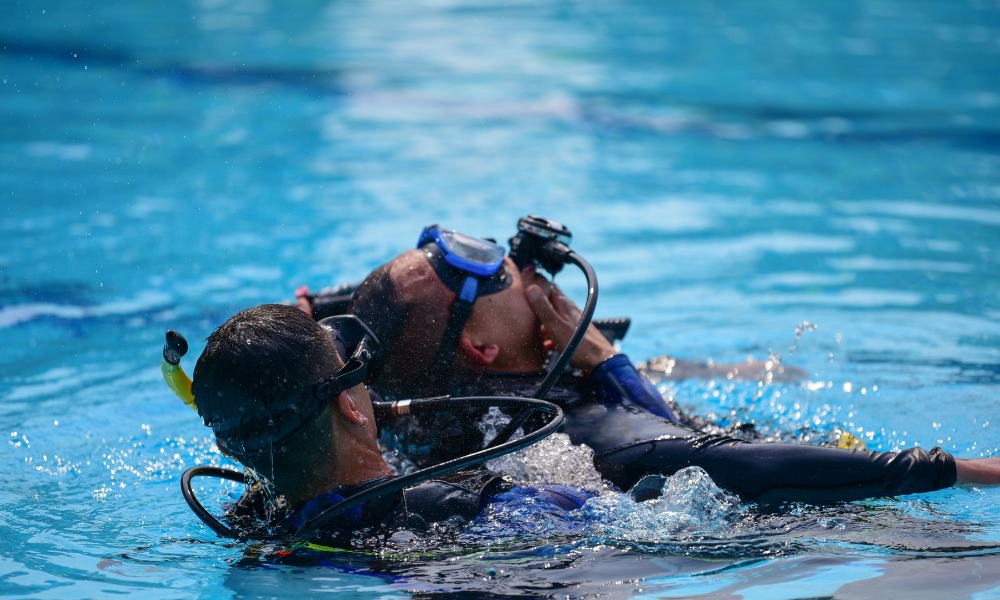
Maintain distance — close enough to help, far enough to stay safe. Watch them. Is their breathing slowing? Are they responsive? Are they making eye contact? If yes, move in, calm them down, take control of the situation. If they’re unresponsive or not breathing normally, you’re moving into rescue breathing — which is beyond the scope of this article but is covered in full in the PADI Rescue Diver course.
A Personal Story From Aliwal Shoal
I want to share one incident that stays with me, because it captures almost everything covered in this article in a single two-minute window.
I was running an Open Water course at Aliwal Shoal — one of South Africa’s best dive sites, and one I know well. We were at around 10 to 12 metres, mid-dive, and I was about to run the fully flooded mask skill. I tend to teach this mid-water rather than on the bottom — sitting on the sand isn’t realistic, and I want students building real skills, not textbook ones. Conditions were slightly surgy that day, but nothing serious.
As my student flooded the mask, I watched the eyes go wide. Not uncomfortable-wide. Panic-wide. The breathing rate spiked immediately — I could see it in the bubble stream. I was close, which turned out to matter enormously.
The mask came off. And I knew — from experience, not from thinking — that the regulator was next.
My instinct was to get my hand on it before it came out. I locked it in place. My student tried to rip it free — and I mean really tried, that adrenaline-fuelled strength that panic produces is real — but I held it. Kept it in. Kept the air supply secure. And then I just started slowly, calmly swimming us upward. My divemaster read the situation immediately, gathered the rest of the group, and brought them up behind us at a controlled rate.
We surfaced without incident. BCD inflated, student breathing, situation under control.
What I took from that dive wasn’t just “catch the signs early” — though that matters enormously, and being physically close enough to intervene made the difference. What I changed after that experience was when I teach mask skills at all.
The PADI standards don’t require you to perform the fully flooded mask in the first ten minutes of the dive. They require it on a specific dive number. That’s it. So I stopped doing it at the beginning. Now I get students down, let them settle, let them enjoy the dive and build a bit of confidence and familiarity with the environment. I gauge their mindset, their breathing, their comfort level throughout. And then — during or at the end, when they’ve had some fun and they’re relaxed — we do the mask skills.
The change was significant. The same skill, in the same water, with the same student profile — but performed from a position of calm rather than a position of anxiety produced completely different results.
If you’re an instructor reading this, consider it. And if you’re a student who has ever been handed a flooded mask three minutes into your first open water dive and felt your heart rate spike — that’s not weakness. That’s a completely normal response to an uncomfortable skill!
So keep practising, keep getting comfortable and master the feeling of water on your face through repetition.
Part Two: What to Do as a Bystander Diver
This section is overlooked in almost every article on panic — but it matters enormously.
The Bystander Panic Problem
When divers witness a panic event, they often panic themselves. It’s called passive panic, and it’s exactly as dangerous as it sounds. A witness who freezes, shoots to the surface, or makes a chaotic decision in response to what they’re seeing can turn a single emergency into three.
The first job of every diver who is not the rescuer is this: manage yourself.
On the Dive
- Do not interfere with the rescue. The guide is handling this. Your intervention, however well-intentioned, adds chaos.
- Do a headcount. In the commotion, it is entirely possible for another diver to keep following a turtle along the reef while the group has already started surfacing. Someone needs to check.
- Group up. Signal the other divers. Cluster together.
- Skip your safety stop — at the depth in this incident (15 metres), the safety stop is not a priority. Get to the surface. A safety stop during a live rescue scenario creates unnecessary time pressure and separation.
- Watch for boat traffic above you before surfacing.
On the Surface
- BCD inflated, mask on, fins on, weights on. Strip your BCD only if you’re getting on the boat. Everything else stays on until instructed otherwise.
- Stay clear of the rescuer and the victim. Give them space.
- Signal the boat. Do not assume someone else has done it. Arm up, whistle, surface marker — whatever you have. Get the boat moving toward you now.
- Think one step ahead. The victim is going to need help boarding the boat. Gear is going to need collecting. The captain may need someone to stay in the water. Get on the boat when you can, move to the back, and start creating space for what’s coming.
The less the rescuer has to think about the group, the better the outcome for the victim.
Part Three: How to Prevent a scuba diving panic.
Prevention is not a checklist. It is a mindset, and it starts before you put your kit together.
Before You Even Get to the Boat
Never take a dive you’re not comfortable with. This sounds obvious. It is routinely ignored. Peer pressure, partner pressure, and ego are responsible for more diver panic events than equipment failure will ever be.
If the dive doesn’t feel right, say so. A good operator will not pressure you. If they do, that is your answer.
Sleep and hydration matter more than most divers acknowledge. Fatigue and dehydration both increase nitrogen absorption at depth, reduce cognitive function, and lower your stress threshold.
A tired, dehydrated diver is a diver with a thinner margin before the spiral begins.
Don’t dive with a hangover. It goes without saying that it is not a good idea, though we all do it – I am not innocent of this either early in my career.
Alcohol is a diuretic and dehydrates you. It also affects your inner ear — which is already under pressure underwater. A hangover is not just an inconvenience on a dive. It is a genuine risk multiplier.
But on top of that, it makes you unclear and reduces your ability to handle tasks effectively underwater.
Gear and Weighting
Know your weight. This is one of the most underestimated issues in recreational diving that can leads to a scuba diving panic.
If you don’t know your weight, get a proper weighting check in confined water before you do an open water dive with a new operator.
Overweighted divers fight their buoyancy from the first minute, burn more air, and start the spiral earlier. Underweighted divers fight to stay down, which creates exactly the same result.
We cover it in more detail in this article: Mastering Scuba Diving Buoyancy
Test new gear in a pool first. A new BCD, a new wetsuit, a new computer — anything that changes the way your kit feels or behaves should be tested in confined water before you take it into open water.
Check your kit yourself. Every single dive. Same order. Every time. Don’t rely on the guide to check it. Don’t rely on your buddy. Run your own check, in your own sequence, until it is automatic.
This is the single biggest gap I see in recreational divers — and it is the gap where most incidents begin.
The Dive Briefing
Ask questions. If you don’t understand the dive plan, say so before you enter the water. Understand the maximum depth, the turn pressure (the air reading at which the group starts heading back), and the signal for something’s wrong.
Going into a dive with unresolved questions is a stress that sits in the back of your mind the entire time.
Speak up if you’re not comfortable. If you’re feeling off — anxious, tired, unwell — tell the guide before you get in. A good operator will work with you, adjust the dive, or keep you at a shallower depth.
If the guide dismisses your concern, that is the wrong operator and the right time to stay on the boat.
On the Dive
Don’t rush your descent. I never did negative entries. I still got to the bottom. The difference is I arrived calm, equalised, and breathing properly — not flustered, fast-breathing, and already behind on air.
Take the descent at your own pace. Let the group wait thirty seconds. It is worth it.
Watch your breathing rate. If you feel your breathing getting faster, stop moving immediately. Do nothing. Hover. Let the air come to you. Long exhales — the exhale is where you drop your heart rate and your CO2 levels.
Breathe as if you’re trying to fog a mirror slowly, not blow out a candle.
Know your air. Build a sense of your air consumption at depth so you’re not constantly checking the gauge in a panic. A rough internal sense — fifteen minutes into this dive at this depth, I should be around here — takes the pressure off the gauge and puts you in a more relaxed relationship with your air supply.
And never push below 50 bar. That final 50 bar is your emergency reserve. Plan as if it’s already gone.
Stay with the group. Separation is one of the most powerful stress triggers in diving. Losing sight of the guide or the other divers — especially in poor visibility — can escalate a calm diver to a distressed one in under a minute.
Fix small problems before they become big ones. Foggy mask? Clear it. Fin strap loose? Sort it. Breathing feeling slightly off? Stop, signal the guide, take a moment.
The single biggest mistake recreational divers make is pushing through minor discomfort in the hope it will resolve itself.
Underwater, small problems compound. The solution is always: stop, deal with it, continue.
The Protocol That Saves Lives
Stop. Breathe. Think. Act.
PADI teaches this at rescue level, but it applies to every diver at every level. The moment something feels wrong — before you try to fix it, before you signal anyone, before you do anything — stop moving. Let yourself hover.
Breathe deliberately. Let the rational brain come back online. Then think about what’s actually happening. Then act.
The difference between a managed incident and a panic event is almost always that protocol.
Panic skips straight to “act” — usually upward, fast, without equipment. A trained diver stops first.
Common Mistakes — What Goes Wrong and Why
Ignoring the pre-dive stress check
Not a gear check. A stress check. Before you get in the water, ask yourself honestly: do I actually want to do this dive? If the answer is hesitation, that hesitation needs to be addressed, not overridden.
Assuming calm on the surface means calm underwater
Many divers feel fine at the surface and begin the spiral on descent. The change in environment — the sound, the pressure, the visibility — triggers something that wasn't there above water. Don't assume how you feel on the boat is how you'll feel at 15 metres.
Over-relying on the guide.
The guide is responsible for the dive plan and for keeping the group together. They are not responsible for your air consumption, your weighting, your gear check, or your mental state. You are. Divers who enter the water assuming someone else will catch them if something goes wrong are setting themselves up.
Chasing the group when you're already stressed.
If you're falling behind and you're anxious, the instinct is to kick harder and swim faster to close the gap. This burns air, raises your heart rate, and accelerates the spiral. The right move is to signal the guide, stop, and let the group come to you.
This is a tricky one, as most of the time the guide could be the reason the group is moving fast and you cannot get their attention or due to conditions. So definitely easier said than done. But try to avoid overexerting yourself as much as possible.
Another thing to remember - currents are less strong at the bottom, so if you falling behind, try dropping closer to the reef.
In extreme cases, you always have the option of making the call to rather surface slowly, inflate your BCD and deploy your SMB (surface marker buoy) and have the boat pick you up.
Staying in a dive you should end.
There is no dive worth injury. If the dive is not going well — if you're stressed, uncomfortable, or genuinely concerned — the right call is to end it. Signal the guide, signal your buddy, and execute a controlled ascent. This is not failure. This is exactly what trained divers do.
Pro Tips — What the Textbook Doesn't Tell You
Visualise before you dive. Before entry, take sixty seconds to mentally walk through the dive. What happens if I get separated? What do I do if my air drops faster than expected? What’s my plan if something goes wrong? Having mental rehearsals for these scenarios means they’re not novel if they occur. And novel problems are what the panicking brain cannot handle.
Make eye contact during the dive. With your buddy, with the guide. Regular eye contact is a communication loop — it confirms everyone is okay, and it means distress is caught early. Divers who stare at the reef and never check in are divers who can spiral without anyone noticing.
Practice the skills you hope you’ll never need. When was the last time you cleared your mask in open water, not just to tick a box but until you were truly comfortable? When did you last practice sharing air with your buddy? The skills that fall apart under panic are the skills that weren’t deeply enough embedded to survive the stress. Get in the pool. Practice until it’s automatic.
Debrief every dive. Not just the bad ones. After every dive, take five minutes with your buddy and ask: what went well? What felt off? Was there a moment where you felt uncomfortable? This kind of honest reflection is what turns experience into wisdom, and it is what separates divers who improve from divers who just accumulate dives.
Key Takeaways
- Panic is not a choice — it is a physiological event that shuts down rational thinking. Understanding this changes how you respond to a panicking diver.
- The spiral starts long before the final trigger. Address the stressors, not just the symptoms.
- As a rescuer: your safety is the first priority. Approach with caution. Control the ascent. Offer air but don’t force it. Keep yourself deflated on the surface.
- As a bystander: manage yourself first. Do a headcount. Skip the safety stop. Signal the boat. Think one step ahead.
- After a rapid ascent: assess for DCI symptoms systematically. Call DAN if anything seems off. Never dismiss symptoms because the dive was shallow.
- Prevention is a mindset: know your weight, check your own gear, never take a dive you’re uncomfortable with, and build air awareness before you need it.
- Stop. Breathe. Think. Act. In that order. Every time.
Continuing Your Education
If this article has made you realise there are situations you’re not sure you could handle — that’s the right reaction. Not panic. Preparation.
The PADI Rescue Diver course is the most significant step any recreational diver can take outside of their initial certification.
It won’t make you responsible for everyone in the water all of a sudden. It will give you the skills, the scenarios, and the instincts to know what to do — and what not to do — when something goes wrong.
I recommend it to every diver I work with, regardless of their experience level.
If you’re a certified diver who hasn’t been in the water for a while, or who wants to sharpen foundational skills before tackling more challenging conditions, consider working with a local instructor on the skills that underpin everything: buoyancy, air management, and emergency procedures.
A few hours in confined water is the best place to build up confidence.
Frequently Asked Questions on scuba diving panic
What causes panic in scuba diving?
Panic rarely has a single cause. It typically builds through a spiral of stressors — overweighting, rapid breathing, low air, poor visibility, separation from the group — that individually are manageable but collectively overwhelm a diver’s ability to cope.
The final trigger (usually low or absent air) is almost never the real cause. It’s the last domino in a sequence that often started before the diver entered the water.
What should you do if you feel yourself starting to panic underwater?
Stop moving immediately. Do not try to swim to the surface, do not try to solve the problem yet — just stop. Let yourself hover or make contact with a reference. Breathe deliberately: long, slow exhales.
Once your breathing slows and your heart rate drops, the rational brain begins to come back online. Then think about what’s actually wrong and what your options are. Then act. The protocol is Stop, Breathe, Think, Act — in that order, every time.
Is it dangerous to ascend rapidly after a panic event?
Yes. A rapid ascent carries risk of Arterial Gas Embolism (AGE) — where expanding air can rupture lung tissue and enter the bloodstream — as well as Decompression Sickness (DCS).
The risk depends on the depth and dive profile, but neither condition should be dismissed, even at shallower depths. After any uncontrolled ascent, the diver should be assessed systematically for symptoms.
If anything seems off, call DAN (+1-919-684-9111 internationally) immediately and administer oxygen if available.
Why do panicking divers remove their regulators and masks?
When panic fully sets in, the prefrontal cortex — the rational, problem-solving part of the brain — goes offline. The brain’s primitive survival system takes over with one instruction: escape. In that state, the regulator and mask are perceived as restrictions rather than life-support.
The diver is not making a conscious decision to remove them — they are responding to an overwhelming instinct to reach air and light. This is why you cannot reason with a diver in full panic. Get them to the surface safely; reasoning comes after.
How do I know if a diver is stressed before it becomes a panic emergency?
Watch the bubbles — a stressed diver has a constant, rapid stream with no pause between exhale and inhale. Watch the body — erratic fin kicks, hands out, poor positioning. Watch the eyes — wide, darting, not making contact. A calm diver looks curious.
A stressed diver looks like they’re looking for a way out. Catching it at the distress stage — before full panic — is where you actually have options. This is the core skill the Rescue Diver course teaches.
Can experienced divers panic underwater?
Yes. Surveys consistently show that 50–65% of recreational divers have experienced a panic or near-panic event — including experienced divers.
Panic does not respect experience. What experience does is increase your repertoire of responses, which means experienced divers are more likely to interrupt the spiral before it reaches full panic.
But experience is not protection. Complacency, fatigue, unfamiliar conditions, and stacked stressors can overwhelm any diver.