
The lesson
6 chapters · about 6 min
Chapter 1: Why buoyancy matters
1 min
Buoyancy is the foundation every other dive skill is built on. Getting it right is a safety skill: it protects you, and it protects the reef you came to see.
It is also how you use less air: a diver who isn't fighting to stay level breathes less and stays down longer.
This lesson turns the physics into a few simple ideas, then gives you exercises to use on your next dive.
Chapter 2: The physics in two minutes
1 min
Archimedes' principle: anything in water is pushed up by a force equal to the weight of the water it displaces. Underwater, two forces pull against each other: gravity pulling you down and the water pushing you up. When they balance, you are neutrally buoyant.
Three things keep changing during a dive:
- Displacement. Your body, your exposure suit and your equipment displace water.
- Weight. The lead you carry, the metal of your tank, even the air inside it.
- Compression. As you go deeper, the bubbles in your wetsuit's neoprene and the air in your BCD compress, so you displace less and get heavier.
That is why you feel heavier the deeper you go, and why the air in your BCD expands as you come up. If you don't vent it, you risk an uncontrolled ascent.
Your suit matters: a 5 mm suit gives much more lift than a 3 mm suit or a rash guard. It needs more weight, and it changes more with depth.
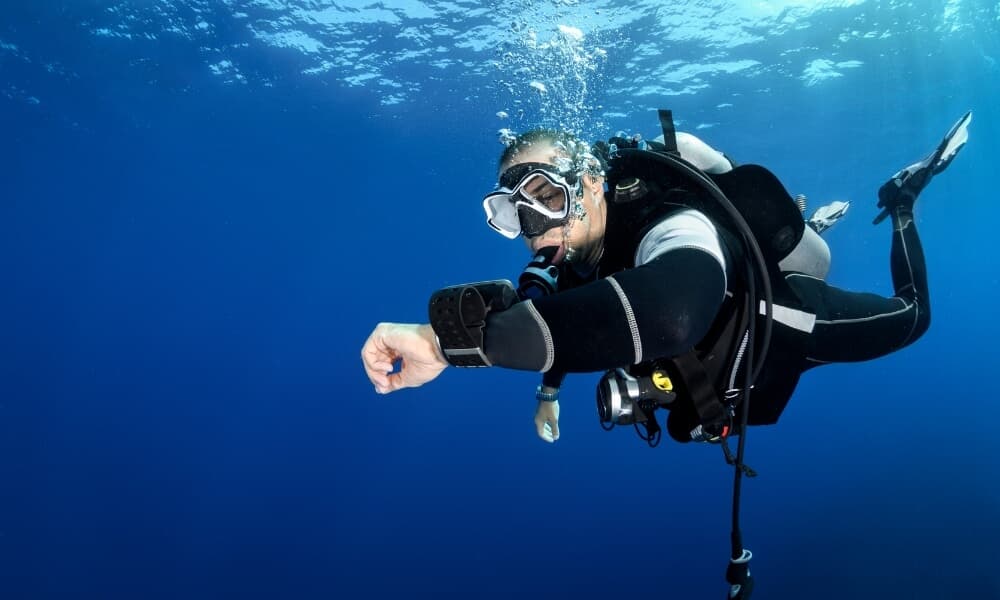
Chapter 3: Your lungs do the fine-tuning
1 min
Your lungs are your main buoyancy control; the BCD is there for what your lungs can't do. Adult lungs hold several litres of air, enough to lift you noticeably.
Use the BCD for the bigger changes that come with depth, and let your breathing handle the small ones. A deeper breath in lifts you; a full breath out helps you sink.
Try this
- Breathe in slowly: you rise.
- Breathe out slowly and for longer: you sink.
- Aim for steady, rhythmic breathing at all times.
Drill, best in confined water: while hovering, try to stay within 30 cm of the same depth using only your breath.
"My rhythmic breathing pattern: 3 seconds in, 7 to 9 seconds out." Manie Eksteen, PADI Staff Instructor
Chapter 4: Get your weighting right
1 min
Most divers carry too much weight. That means more air in the BCD to stay level, and a big air bubble that shifts around makes you unstable.
The weight check: at the surface, in full gear, with your regulator in and your BCD empty.
- Hold a normal breath.
- You should float at about eye level. That tells you you're not too heavy.
- Breathe out: you should sink slowly. That tells you you're not too light.
- Then inflate your BCD, adjust your weight if you sink fast or float high, and have an instructor check your weighting.
Holding that breath is for this surface check only. On scuba, never hold your breath: even a few metres can injure you if you do.
Air has weight, so a full cylinder makes you heavier than the same cylinder near the end of a dive. For the most accurate check, do it near the end of a dive, never with an empty cylinder: always surface with at least 50 bar (about 725 psi) in reserve.
Where the weight sits: spread it evenly left and right so you don't roll. Use the trim pockets on the back of the BCD only for distribution, and with floaty aluminium tanks rather than steel. Before you giant-stride in, check every weight pocket is clicked in: it is part of your pre-dive safety check.

Chapter 5: Trim, hover and kicks
1 min
Trim is your position in the water. Aim to be horizontal: it cuts drag and stops your kicks pushing you upwards.
Where the lead sits matters as much as how much you carry:
- Legs sinking? Move weight higher: higher pockets on the BCD, or onto the tank strap.
- Legs floating up? Move weight towards your hips, or add ankle weights.
Keep most of your lead where you can drop it.
The hover: practise staying perfectly still for sixty seconds, using only your lungs for small corrections. Keep your hands still: if you are sculling with them, you aren't neutral yet.
Kicks: in delicate places such as the SS Thistlegorm, a frog kick instead of a flutter kick keeps the silt down and the wreck undamaged.

Chapter 6: Stop floating up
1 min
The "runaway" ascent is one of the most common frustrations for newer divers, and avoiding it comes down to anticipation.
As you come shallower, or swim up and over a pinnacle, the air in your BCD expands. If your head is lower than your body, that air tends to move down towards your hips.
Keep breathing as you come up, and never hold your breath. Get your head above your body (head up, feet down) and vent small amounts often on the way up, rather than waiting until you feel pulled towards the surface.
Fighting your buoyancy, whether from technique, too little weight or too much, raises anxiety and can even lead to panic. What to do about panic underwater
Remember
- Your lungs fine-tune; the BCD handles the changes that come with depth.
- Check your weighting at the surface with a normal breath and an empty BCD: most divers carry too much.
- Stay horizontal, and move weight to fix sinking or floating legs.
- Practise a sixty-second hover with your hands still.
- On the way up: keep breathing, head up, and vent a little, often.
In short
Every new suit, tank or kind of water needs a small recalibration of your weights. Practise regularly in confined water, stay mindful of your breathing, and keep refining your technique.