
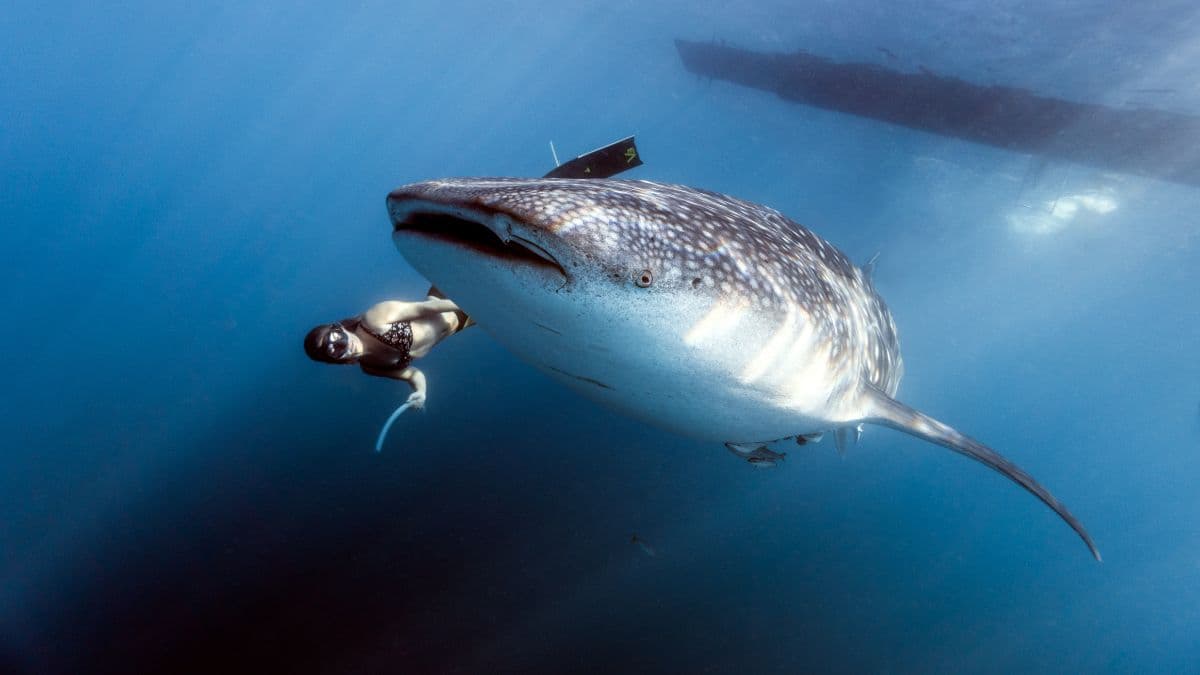
South Ari is a snorkelling trip first and a diving trip second. Whale sharks are recorded here every month of the year, and the reef and channel diving around them is good.
But the sharks feed near the surface, so scuba is the wrong tool for the main event. How you behave in the water also matters more here than at most Maldives sites.
Why the whale sharks stay
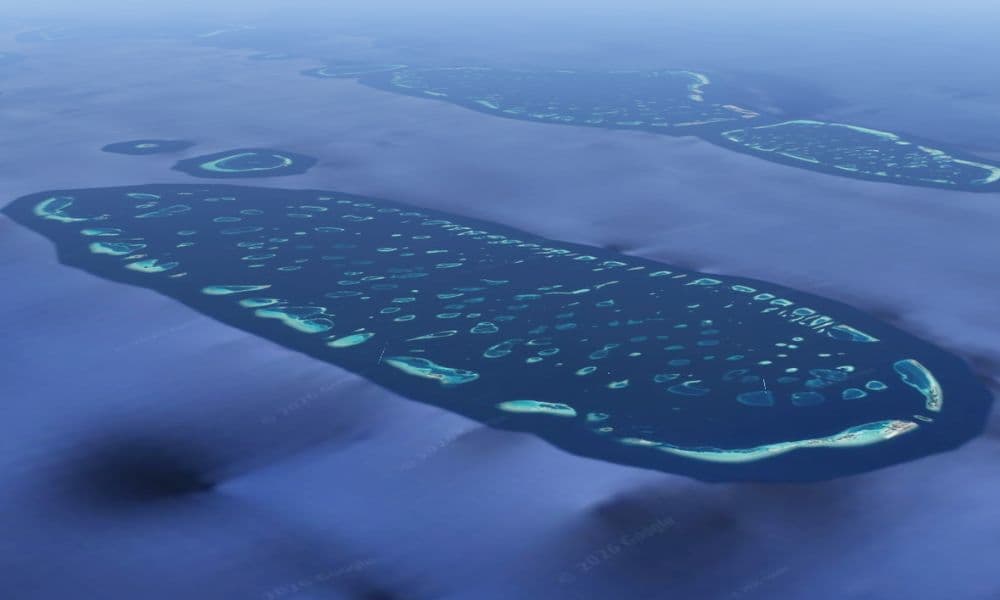
South Ari is the southern half of Ari Atoll, roughly 90 kilometres south-west of Malé. A barrier reef encircles it, and the channels through that reef pull nutrient-rich current into the lagoon.
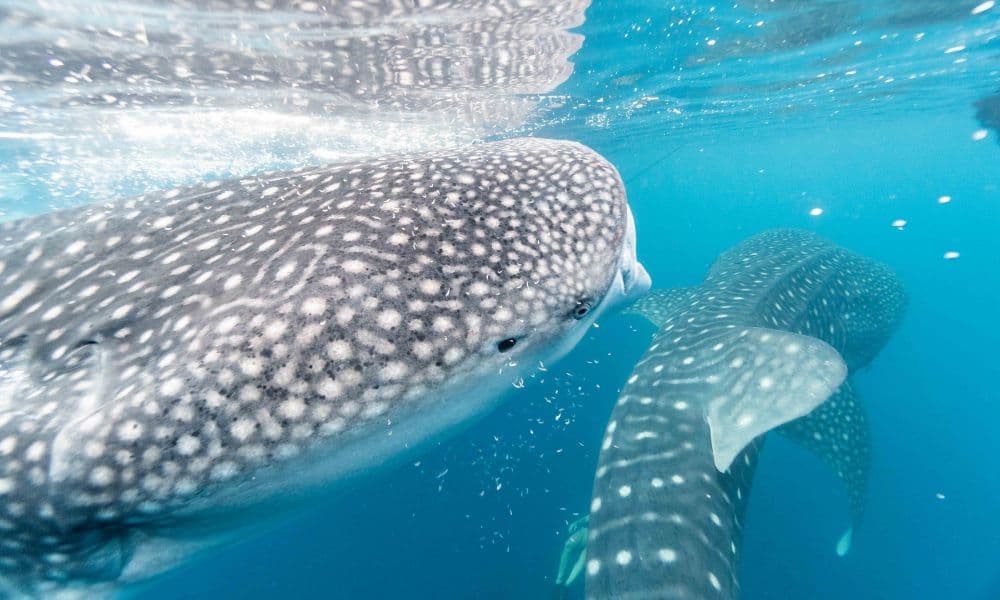
The sharks are mostly juvenile males, typically 4–6 metres long. They feed on plankton and fish spawn that the current concentrates near the surface.
Because they are feeding rather than passing through, they stay. That is what separates South Ari from a seasonal aggregation.
Whale Shark Point (Maamigili Beyru) lies in the South Ari Marine Park, which the Maldivian government established as a marine protected area in 2009 (Visit Maldives).
Snorkel with the sharks, dive the rest
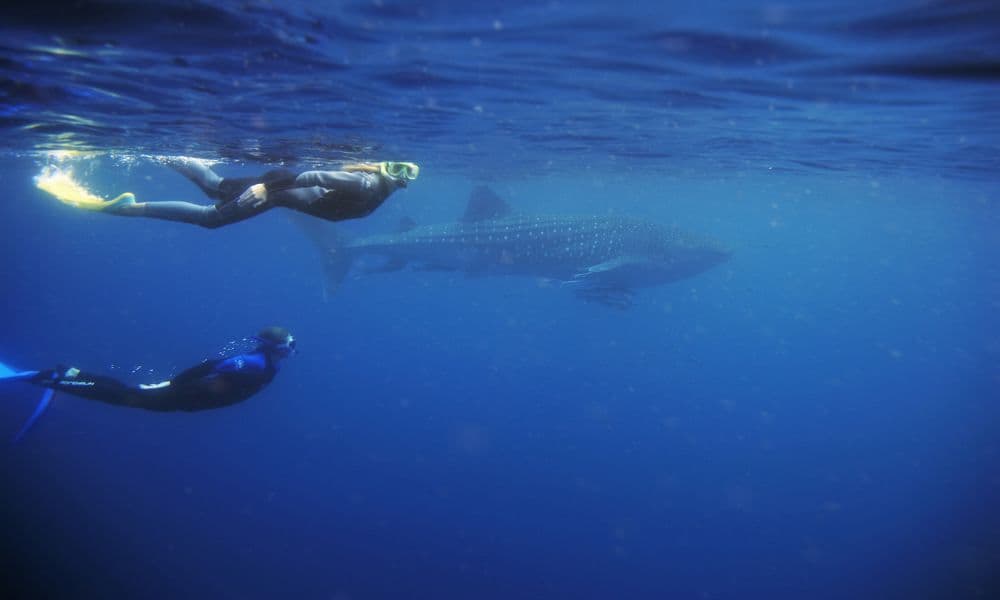
The sharks feed in the top 5 to 15 metres, following the plankton. A snorkeller at the surface is in the feeding zone, eye to eye with a shark.
A diver at 10–12 metres is below the action, looking up at the underside of a shark that is busy with something else. The water is shallow and the current gentle, so there are no technical demands.
Whether scuba bubbles disturb feeding whale sharks is not settled. A peer-reviewed paper on whale shark tourism, citing earlier work, says the sharks routinely avoid close approaches by swimmers and boats, and that a dedicated study of divers at a Belize site found no direct effect on them (Haskell and others, Oryx, 2015). The stronger reason to snorkel is depth: the sharks feed near the surface.
Many experienced South Ari operators now run whale shark trips on snorkel gear only. If your boat or resort offers both, snorkel.
Scuba comes into its own at the other sites around the atoll. For the main encounter, leave the tank on the boat.
How to behave around the sharks
These are wild animals in a protected area. What you do decides the encounter for everyone in the water, and the sharks' wellbeing over time. Responsible operators work to guidelines from marine conservation groups, including the Maldives Whale Shark Research Programme. Its code of conduct, as Visit Maldives lists it, includes no touching, no flash and no blocking the shark's path.
- Distance. Stay at least 3 metres from the shark and 4 metres from the tail. A sudden tail movement can injure you.
- No touching. Touching strips the protective mucus from the skin and stresses the animal. If a shark swims towards you, you move away.
- No flash. Switch it off before you enter the water.
- Alongside, never in front. Swim parallel at the shark's pace. If you cut across its path, it has to change course and stops feeding.
- Group size. Responsible operators cap how many people share the water with one shark. Follow your guide on when to enter and when to give the shark space.
Operators who let groups mob a shark, allow fin-riding or ignore the no-touch rule do real damage. Ask how yours manages encounters before you book. A reputable South Ari operator can describe its protocol clearly.
Dive sites beyond the whale sharks
The atoll has a full reef ecosystem, and three kinds of dive stand out.
Mantas. They visit cleaning stations on the outer reef edges from May to October, when the south-west monsoon drives plankton production. The encounter is close and unhurried, and it often repeats on consecutive dives. It is a different thing from the mass feeding at Hanifaru Bay, where 50–200 mantas feed together.
Reef walls. The outer walls hold grey reef sharks, white-tip reef sharks, eagle rays and healthy coral gardens. The atoll's protected status keeps fish numbers comparatively strong, so the reef has not been stripped of life the way busier sites can be.
Channel drifts. Current through the outer channels pushes nutrients in and draws schooling barracuda, trevally and the occasional hammerhead at depth. You need to be comfortable in current, with Advanced Open Water at minimum.
Four sites to know. Only the first is a snorkel, and Open Water divers should stay on the shallower reefs and shallow thilas such as Thudufushi.
| Site | What you find | Level |
|---|---|---|
| Maamigili Beyru (Whale Shark Point) | Whale sharks over a sandy bottom with scattered coral, 5–15 m. All year, with the best success rates June to October | Snorkellers and Open Water |
| Fish Head (Mushimasmingili Thila, North Ari) | A protected seamount with resident grey reef sharks and nurse sharks resting on the sand. The current can run strong | Advanced Open Water recommended |
| Hammerhead Point | Outer channel site with hammerheads in blue water off the channel edge at 20–30 m. Early morning is the best window, and sightings are not guaranteed | Advanced Open Water |
| Thudufushi Thila | Shallow thila, 10–18 m, with strong coral and dense fish. Good for macro and reef photography, and less dependent on current | Open Water |
When to go
The sharks are here all year. June to October is strongest, and January to April has the clearest water.
| Months | Whale sharks | Mantas | Visibility |
|---|---|---|---|
| January to April | Strong | Rare | 20–30 m |
| May | Strong | Building | 15–25 m |
| June to October | Very strong | Peak | 10–20 m |
| November to December | Good | Reducing | 20–30 m |
June to October is the south-west monsoon. The surface is rougher, but the same plankton feeds the sharks and draws the mantas, so this is the best window to see both on one itinerary.
Visibility drops on high-plankton days. Treat that as a good sign: the feeding is strong.
For the whole country, see the best time to dive the Maldives.
Liveaboard or resort?
A Maldives liveaboard is the stronger choice for serious divers. A boat based in or passing through South Ari gives you several days at the atoll, first-light access to Rangali Madivaru before day visitors arrive, and the freedom to follow conditions instead of a fixed daily schedule. Central itineraries that cover South Ari, North and South Malé and Baa (for Hanifaru Bay snorkelling) are the most efficient way to see the range of Maldivian marine life in one trip.
A resort works if you want a fixed base and mainly the whale shark encounter. Several South Ari resorts run their own dive centres with direct access to Maamigili Beyru. The trade-off is range: outer-atoll sites mean longer boat transfers.
Ready to look at boats?
Questions
Are whale sharks at South Ari guaranteed all year?
No. Wildlife keeps no schedule.
Encounters are common all year. Our season data rates June to October highest, though some studies of the resident sharks find no clear monthly pattern, so read it as better odds, not a guarantee. Several days at the atoll improve your odds, so a liveaboard that stays in South Ari beats a single day trip.
Is South Ari better for snorkelling or scuba?
For whale sharks, snorkelling. The sharks feed in the top 5–15 metres where snorkellers are in the action, and scuba bubbles can disturb them. For the reef and channel sites, such as Rangali Madivaru, the outer walls and the channel drifts, scuba gives the full experience.
When is the best time to see whale sharks at South Ari?
All year, but June to October, during the south-west monsoon, brings the highest frequency and the largest aggregations. January to April has the clearest water and still-strong whale shark numbers.
Can beginners dive South Ari?
The whale shark snorkelling suits every level. Easier reef sites such as Thudufushi Thila suit Open Water divers.
Rangali Madivaru, Fish Head in North Ari and the current sites need Advanced Open Water and current experience. Come with Open Water as a minimum and enjoy the sharks and the shallower reefs.
How do I get to South Ari from Malé?
Resorts in the atoll are reached by seaplane from Malé (about 30 minutes), or by domestic flight to Maamigili airport and a short boat transfer. Liveaboards leave from Malé and reach South Ari after an overnight passage, so the boat does the work of getting you there.
What are the whale shark encounter rules at South Ari?
In the South Ari Marine Park: stay 3 metres from the shark and 4 from the tail, no touching, no flash, swim alongside rather than in front, and never block its path. Responsible operators brief guests before they enter the water. Sharks that are harassed repeatedly become harder to find, so following the rules keeps the site productive.