
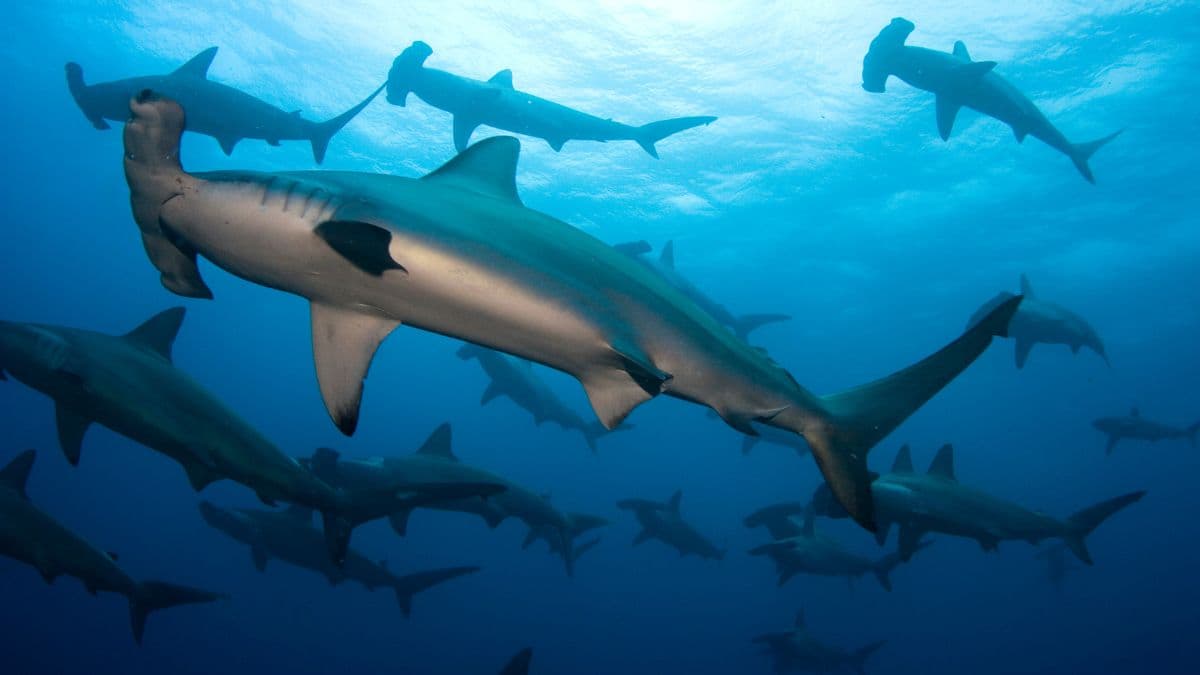
When to dive Banda Sea hammerheads
The Banda Sea is not a year-round destination. Heavy monsoon winds raise large swells for much of the year, so hammerheads can be dived in two calm windows only.
| Window | Season | What to expect |
|---|---|---|
| September to November | Peak | The water cools slightly, which draws hammerheads up to recreational depth. Late September to mid-October is the peak in our season data. |
| March to April | Good | The seasons are changing. Hammerheads are still there, but the schools are usually smaller than in autumn. |
| Other months | Off | Swells are heavy. June and July are the roughest, and in December boats have moved to Raja Ampat or Komodo. |
The IUCN Shark Specialist Group's Important Shark and Ray Area factsheets back the autumn window and the group sizes. At Manuk, annual aggregations of 20–50 scalloped hammerheads, up to about 80, are seen between September and November. At Nila-Serua they come in October and November, with more than 200 sharks at Serua. At the Banda Islands, 80–200 gather at Hatta and Suanggi, and the larger aggregations that dive operators focus on are seen from mid-September to early December.
Water is 25–27 °C and visibility runs 15–40 m. That sounds warm, but most dives are spent hanging in blue water and you can get cold. Wear a full suit, 3 mm or 5 mm with a hood.
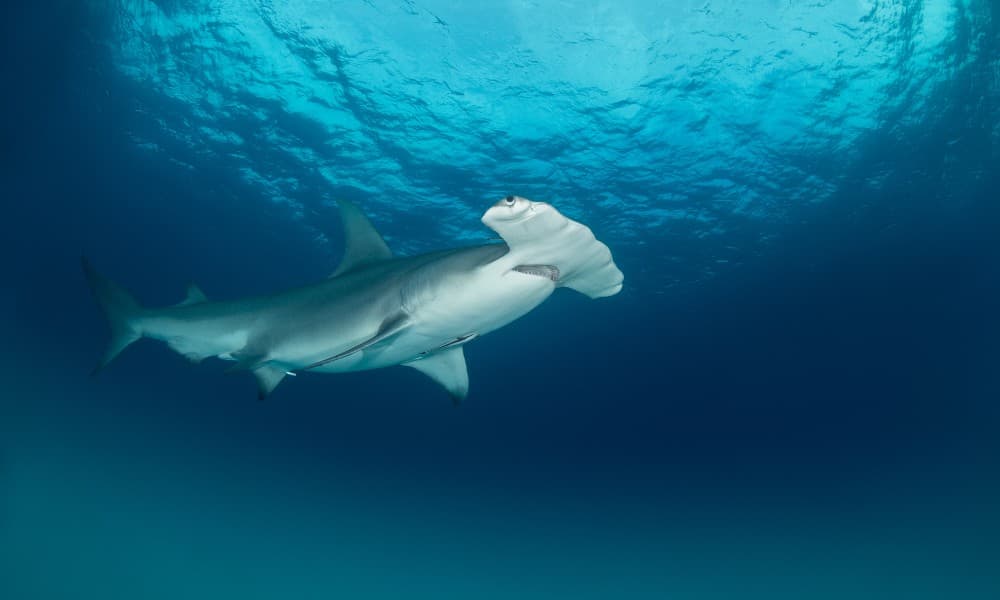
Where the hammerheads are
The Banda Sea is a remote stretch of eastern Indonesia, often called the Forgotten Islands or the Ring of Fire. Volcanic peaks rise from depths of more than 4,000 m. The sharks come up from the deep to visit these submerged mountains.
Pulau Koon is often where divers see their first hammerheads. Manuk is most consistent in October.
| Site | What you find |
|---|---|
| Pulau Koon | On the edge of the Ceram shelf, a natural bottleneck for marine life with big schools of snapper and grouper. Often the first place divers spot hammerheads on the way deeper into the Banda Sea. |
| Manuk (Snake Island) | An active volcano rising from the deep, with vents that release bubbles. Known for hundreds of sea snakes on its reefs. The outer walls drop vertically and are a prime spot for sharks. |
| Nilu and Damar | The inner arc of the Ring of Fire, with powerful currents. Divers hook into the reef at a corner and watch the blue. In the right conditions, dozens or even hundreds of scalloped hammerheads glide past the reef edge. |
Skills and kit
This is not a destination for beginners. The sites are remote, the current is strong, and you watch your depth carefully in the blue.
- Advanced certification and 50 to 100 logged dives. Most liveaboards ask for this minimum.
- A reliable dive computer. Deep walls mean watching your depth and your no-decompression time closely. To choose one, read the dive computer guide.
- A surface marker buoy (SMB). It is mandatory. If you are separated from the group in the blue, it is your only way to signal the chase boat. DAN lists a surface marker buoy as equipment divers should take on most dives (DAN).
- A reef hook. It lets you wait for the sharks without damaging the reef or tiring against the current.
Approach the sharks slowly
The hammerheads here are scalloped hammerheads. They are social and travel in synchronised groups that can number in the hundreds. Unlike the tiger sharks in Are tiger sharks dangerous to scuba divers?, they are shy.
They are sensitive to bubbles and loud noises. Stay still, breathe slowly and do not swim at the school. It is a game of patience.
Getting there on a liveaboard
Trips leave from Ambon or Sorong. The islands are far apart, so a liveaboard is the only practical way to dive here. Unlike the Red Sea, a Banda Sea trip means several domestic flights and days at sea.
Many divers combine it with Raja Ampat on a crossing trip, which can take in the muck diving at Ambon, the hammerheads of the Banda Sea and the coral gardens of the south.
The best liveaboards often book out more than a year ahead, so start early.
Ready to look at boats?
Questions
When is the best time to dive with hammerheads in the Banda Sea?
September to November, with late September to mid-October the peak in our season data. March to April is a second window, with smaller schools. Heavy monsoon swells make the other months unreliable.
Can beginners dive the Banda Sea?
No. Most liveaboards require Advanced certification and at least 50 to 100 logged dives, because the sites are remote and the current is strong.
How do I get to the Banda Sea?
Join a liveaboard that leaves from Ambon or Sorong. It is the only practical way, given the distances between the islands.