
The lesson
4 chapters · about 4 min
Chapter 1: Why your mask fogs
1 min
Every diver has done it. You roll in, clear your mask at depth, and within thirty seconds the lens has fogged. You can see shapes and colours, and nothing else.
A fogging mask is almost never a mask problem. It is a technique problem, and once you know why it happens, defogging is straightforward.
Fog forms when warm, humid air from your face meets a cooler glass surface. The moisture condenses into tiny droplets, and the droplets scatter light. Untreated glass sits somewhere between hydrophilic (water spreads evenly across it) and hydrophobic (water beads into droplets), and it naturally attracts droplets.
Anti-fog products deposit a thin hydrophilic film on the glass, so condensing moisture forms a uniform, invisible sheet instead of droplets. It is the same principle as the anti-fog coatings on swimming goggles and car windscreens. You are not stopping condensation. You are changing how it sits on the glass.
Most divers defog incorrectly because they undo the film before it has time to form.
Chapter 2: New masks: remove the coating first
1 min
A new mask fogs worst, and the reason is the glass. Most tempered glass lenses carry a thin protective coating from manufacture, there to protect the glass in production and transit. It is not meant to stay, and it stops the anti-fog film bonding properly. Even the best defogger cannot fully overcome it, so remove it before you dive the mask.
The toothpaste method
Apply a small amount of plain white, non-gel, non-whitening toothpaste to the inner lens. The mild abrasive breaks down the coating without scratching the glass. Rub it in small circles across the whole lens with your finger, leave it for a minute, then rinse and repeat. Depending on the mask, this can take a dozen passes.
Don't rush it: apply, rub, rinse, repeat. It is working when water sheets across the glass evenly instead of beading.
If you would rather not do this yourself, ask your dive shop to prepare a new mask for you.
Some masks respond in one toothpaste session. Others need several sessions across a few days before they reliably stop fogging.
Why older masks fog less
A three-year-old mask often gives far less trouble than a new one, and it is not luck. Over many dives the coating gradually breaks down, so anti-fog bonds more easily and less condensation builds up. Time and use achieve what the prep would have done faster.
Chapter 3: The step that gets skipped: don't rinse the film off
1 min
This is where most divers lose it, even divers who have done it for years.
The usual sequence on a dive boat: someone spits in their mask, swirls it round, immediately rinses it thoroughly with fresh or salt water, and puts it on. That full rinse is the problem. Saliva or commercial defogger leaves a thin film on the glass, and the film needs time to bond and dry. Rinse it off at once and you have removed it before it could form. You are now diving with a wet mask and no barrier, which is the same as not defogging at all.
The correct timing
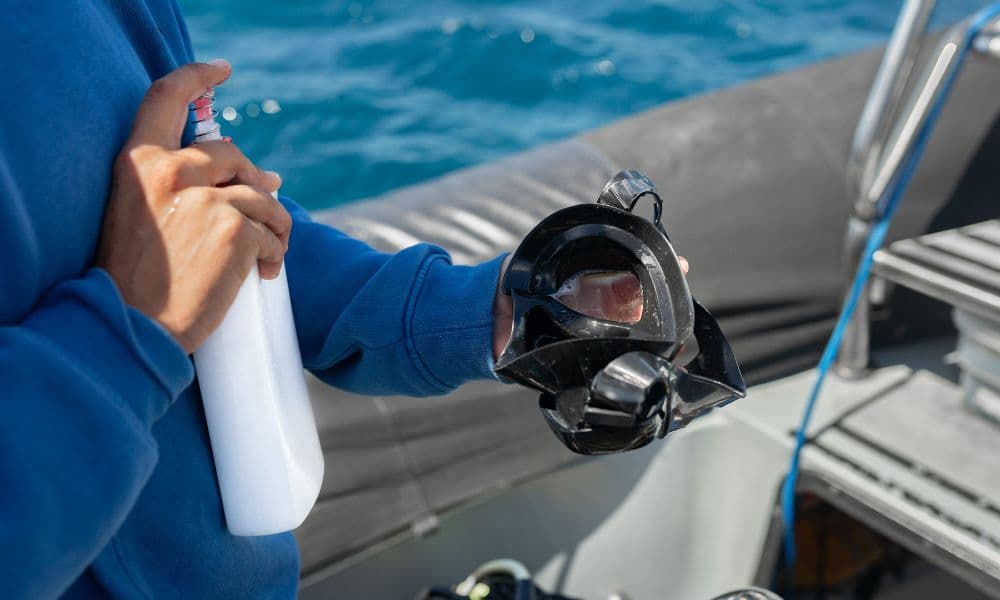
Defog during your pre-dive safety check, not at the water's edge just before you enter. Apply the defogger while you run through your buddy check, and let it sit and dry for at least a minute. When you are ready to enter, rinse once, lightly, with just enough water to wet the lens, and put the mask on.
That light rinse removes excess product and salt and leaves the film on the glass where it needs to be. The film is what stops the fog. Removing it defeats the whole process.
Chapter 4: Defogging step by step
1 min
- New mask: remove the coating first. Run the toothpaste prep until the glass sheets water instead of beading it.
- Apply during your buddy check. Spit (genuine saliva, not dry lips) or put a drop of commercial defogger on the inner lens, and spread it evenly across the whole lens with your finger. Commercial products such as Stream2Sea or Sea Gold, which their makers sell as reef-safe, are worth carrying on liveaboards where you are doing four dives a day.
- Let it sit. Put the mask around your neck and leave it alone. One minute is fine, and longer is better. The film bonds to the glass and begins to dry.
- Rinse lightly, not fully. When you are ready to enter the water, rinse the lens once with a small amount of water. Swish, don't scrub. Rinse too early and you dilute the film you are trying to apply, and the mask will fog.
- Keep the mask on. Each time you take your mask off at the surface, the glass re-equilibrates to the air. When you put it back on, warm air hits cooler glass, your film has been partly disrupted by handling, and the fog comes back. Once it is on, keep it on until the dive is finished. On a liveaboard that means mask on at entry, on at the surface, and off only once you are back on the dive deck. Re-apply before the next entry and repeat the steps.
Try this
On your next dive, defog during the buddy check, wait a full minute, rinse once, lightly, and keep the mask on until you are back on deck.
Remember
- Fog is a surface problem: a thin film on the glass makes moisture form an even sheet instead of droplets.
- A new mask fogs because of the coating on the glass. Remove it with toothpaste before anything else works.
- Apply defogger during your buddy check and let it sit for at least a minute.
- Rinse once, lightly. Swish, do not scrub: you want the glass damp, not stripped.
- Once the mask is on, keep it on until the dive is finished, and re-apply before the next entry.
In short
Fogging is a surface chemistry problem, not a mask quality problem. New masks fog because of the manufacturer's coating, so remove it first with toothpaste, or ask your dive shop to prepare it, before anything else works. Apply defogger during your buddy check, let it sit and form a film, then rinse lightly and keep the mask on. The most common mistake is rinsing thoroughly right before entry, which removes the film you just spent a minute building.
Questions
Why does my scuba mask keep fogging up?
A new mask fogs because of a protective coating applied to the tempered glass lens during manufacture. The coating stops anti-fog products bonding properly, and until it is removed, with toothpaste or a dive shop's mask prep, no defogger will work consistently. On an older mask that has been used regularly, recurring fog usually means the defogger is being rinsed off too thoroughly before the film has time to form.
Does spit actually work to defog a scuba mask?
Yes. Genuine saliva contains proteins and enzymes that create a hydrophilic film on glass, much like a commercial defogger. Spread it across the lens, let it sit for at least a minute, then rinse lightly. The usual mistake is rinsing it off immediately and completely, which removes the film before it can work.
What is the best defogger for a scuba mask?
Commercial defoggers (Stream2Sea and Sea Gold are widely used on liveaboards, and their makers sell them as reef-safe) work better than spit when you are doing several dives a day and need reliable clarity. For casual diving, spit applied correctly performs well. Avoid any defogger with strong detergents that can irritate eyes. Baby shampoo diluted with water is sometimes recommended, and it works on the same principle as commercial products.
How do I stop a new scuba mask from fogging?
Before your first dive, scrub the inner lens in small circles with plain white, non-gel toothpaste, then rinse and repeat. Depending on the mask, this may take several sessions over a few days. Or ask your dive shop to prepare a new mask for you. Once the glass sheets water evenly instead of beading it, the coating is gone and your defogger will work properly.
Should I rinse my scuba mask after applying defogger?
A light rinse, enough to wet the lens and take off most of the product. A full, thorough rinse is the problem: it removes the film before it has bonded to the glass. Apply during your pre-dive buddy check, let it sit for a minute, then swish lightly rather than rinsing fully.
Why does my mask fog after I take it off between dives?
Every time you remove your mask, the glass adjusts to the air temperature. When you put it back on, warm air from your face hits cooler glass and condensation forms. The film is also partly disrupted each time the mask is handled. The simplest fix is to keep your mask on from entry until you are done diving.